“Trust is the glue of life. It’s the most essential ingredient in effective communication.” — Stephen R. Covey.
Over the past few weeks in our Modern Leadership Skills That Matter Now series, we’ve been redefining what leadership looks like today. We started with leading in a hybrid world—where presence matters more than proximity. Then we explored the shift from controlling to coaching: developing people instead of managing every move. Last week, we focused on feedback that builds trust, not fear: turning conversations into growth opportunities.
Now we bring it all together with one of the biggest leadership tensions: accountability.
Because every leader wants results—but not at the cost of trust.
The Reality Tension
Let’s be honest: accountability is where things often break down.
You assign responsibility. You set expectations. But when things don’t move the way you expected, what happens?
You check in more.
You follow up more.
You get closer to the work.
Before long, you’re not leading; you’re hovering.
That’s where most professionals get stuck.
Most people think accountability requires control. In reality, too much control destroys accountability.
When leaders overmanage:
Ownership decreases
Initiative fades
Trust erodes
People don’t step up; they step back.
The Shift That Changes Everything
Here’s the shift:
Accountability isn’t about tracking people. It’s about trusting people, with clarity. Hello?
That distinction matters.
Controlling leaders monitor activity.
Effective leaders create ownership.
Think of it this way…
Micromanagement says:
“I need to make sure this gets done.”
Trust-based accountability says:
“You own this, and I trust you to deliver.”
But here’s where things begin to shift.
When expectations are clear and trust is present, accountability doesn’t have to be forced; it becomes natural.
What Trust-Based Accountability Actually Looks Like
Let’s break this down into practical strategies you can apply immediately.
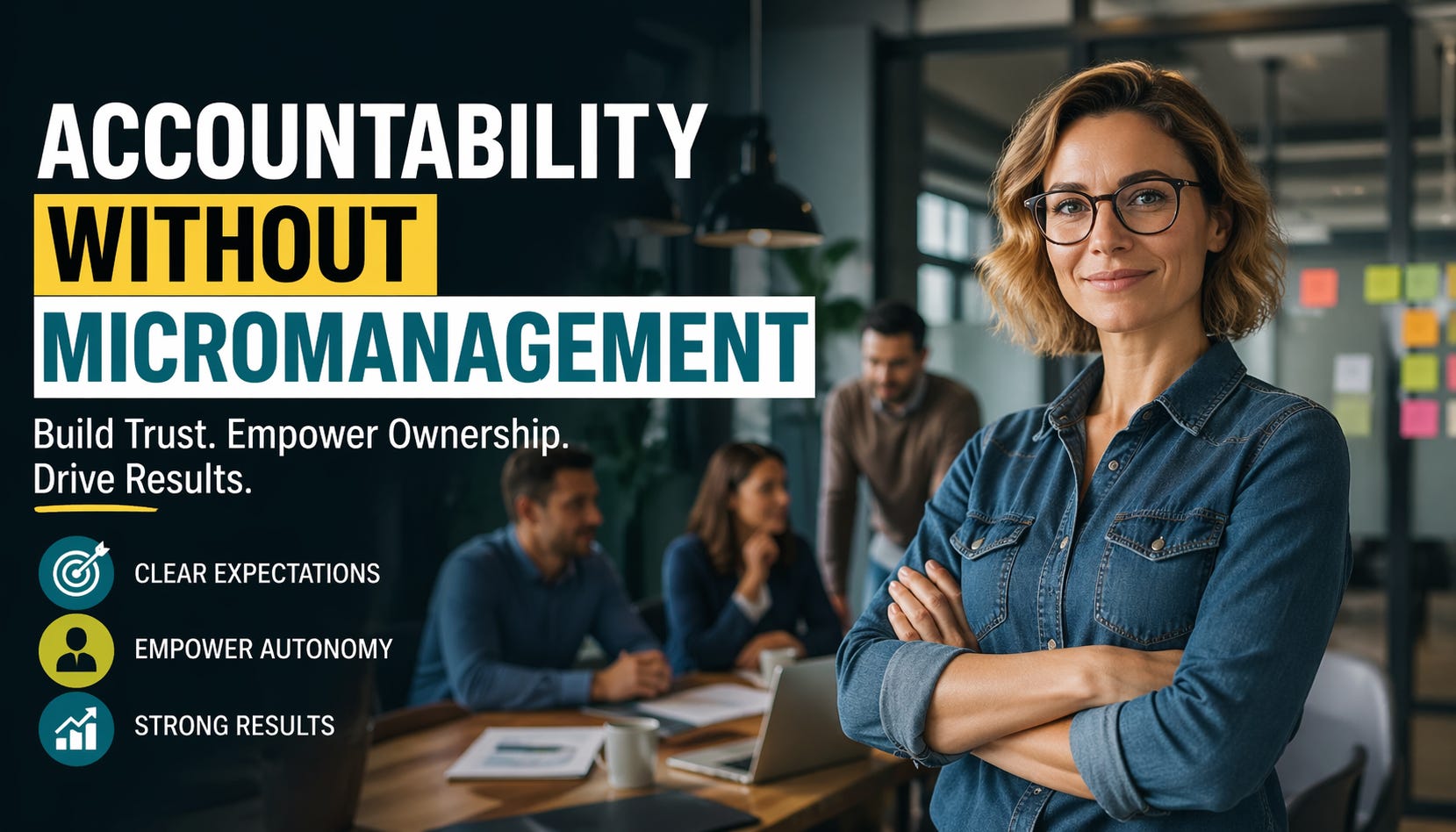
1. Define Outcomes, Not Just Tasks
One of the biggest reasons accountability fails is a lack of clarity.
Leaders assign tasks—but don’t define success.
So people stay busy, but results vary.
Strong leaders define:
What success looks like
Why it matters
What “done” actually means.
Think of it this way:
Tasks tell people what to do.
Outcomes tell people what to achieve.
And outcomes create ownership.
2. Establish Ownership Up Front
If everyone is responsible, no one is responsible.
Clarity of ownership is critical.
Ask:
Who owns this?
Who is accountable for the result?
Not the team, not the group.
A person.
Ownership creates accountability, ambiguity kills it.
3. Create Checkpoints, Not Control Points
This is where many leaders over-correct.
You don’t need constant oversight; you need intentional alignment.
Set agreed-upon checkpoints:
Progress updates
Milestone reviews
Key decision moments
This keeps work on track without hovering.
Checkpoints create alignment. Control creates resistance.
4. Let People Own the “How.”
This is the hardest part for many leaders.
You know how you would do it. You have done it before. You want it done right.
So you are tempted to guide every step.
But here is the reality check:
Most people think accountability means controlling the process. In reality, it means trusting people with the process.
Define the outcome. Set the expectation.
Then, step back.
Because ownership doesn’t grow when you control; it grows when you trust.
5. Address Gaps Quickly and Constructively
Accountability without follow-through is just intention.
When expectations aren’t met, address it quickly and clearly.
But remember what we covered last week:
Feedback should build trust, not fear.
So when you address gaps:
Stay specific
Stay objective
Stay focused on growth.
This reinforces accountability without damaging the relationship.
Reflection & Application
Let’s make this personal.
Where are you stepping in too often instead of stepping back?
Are your expectations truly clear—or assumed?
Who on your team needs more ownership from you right now?
Because accountability isn’t built through pressure; it’s built through clarity and trust.
Action Steps for Trust-Based Leadership
Think back to the entire journey this month.
Leadership today isn’t about control.
It’s about clarity.
It’s about trust.
It’s about developing people who can perform without constant oversight.
Accountability without micromanagement is not only possible; it’s necessary.
Because the moment your team depends on you for everything, you have limited their potential.
So here’s your challenge:
This week, choose one area where you can step back and create more ownership. Define the outcome clearly. Assign responsibility. Set a checkpoint, and trust the process.
Start there.
And if you’ve been following this series, now is the time to go deeper. Explore the EXCEL2WIN archives for more leadership insights, and make sure you subscribe to the EXCEL2WIN Leadership Newsletter to continue building the skills that matter now.
Because leadership isn’t about doing it all yourself.
It’s about building people who can.

What kind of leader are you building—one who gets results, or one who multiplies them?
That’s the powerful question at the heart of Multipliers by Liz Wiseman.
Wiseman introduces a compelling contrast between two types of leaders: Diminishers, who unintentionally limit the intelligence and capability of their teams, and Multipliers, who amplify it. Multipliers don’t just get work done—they create environments where people think more, take ownership, and perform at their best. The book is filled with practical insights on how to shift your leadership approach to unlock the full potential of those around you.
And this connects directly to what we’ve been building throughout this series—especially the idea of accountability without micromanagement.
Micromanagers create dependency. Multipliers create ownership.
When you lead like a Multiplier, you define clear outcomes, trust your people, and step back—allowing them to rise to the challenge. You don’t lose control—you gain stronger, more capable teams.
Because real leadership isn’t about doing more—it’s about enabling more.
If you’re ready to elevate your leadership and build a team that thrives without constant oversight, this book is a must-read.
Pick up your copy today and take your leadership to the next level. And be sure to subscribe to The EXCEL2WIN Leadership Newsletter for more insights that help you grow, lead, and win.