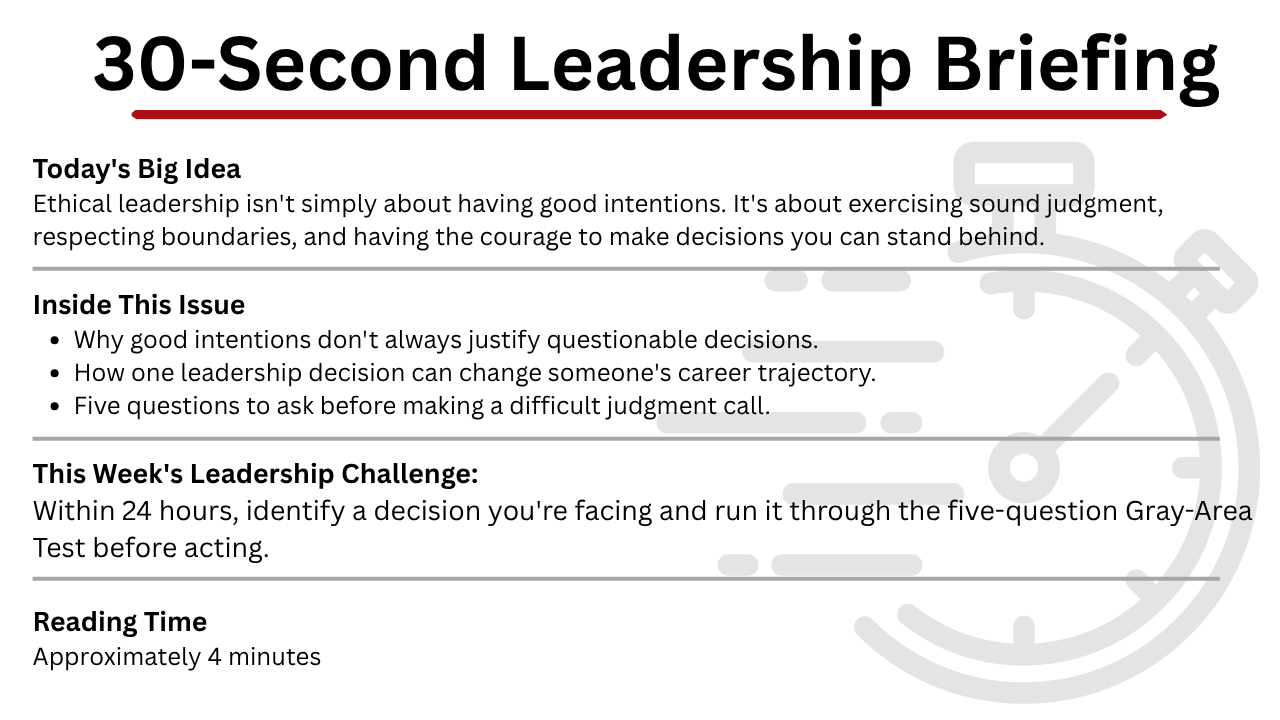

“The opportunity to act does not automatically give you the authority or wisdom to do so.”
Imagine arriving at a new company, eager to begin your leadership responsibilities, only to be handed an employee’s personnel file and instructed to terminate him.
No introductions. No opportunity to observe his performance. No conversation with the employee. Just an expectation that you would carry out someone else’s decision.
What would you do?
Would you follow the directive because it came from senior leadership? Would you challenge it and risk creating tension on your very first day? Or would you take ownership of a decision you hadn’t yet examined?
Sometimes the greatest test of leadership isn’t deciding what to do. It’s having the courage to question what you’re being asked to do.
When Leadership Requires More Than Compliance
Early in my tenure at a new company, I encountered that exact situation. On my first day, senior leadership handed me an employee’s file and instructed me to fire him.
The young man had been with the organization for some time, and his performance was considered inadequate.
I understood the concern, but I wasn’t comfortable making such a consequential decision without personally evaluating the circumstances.
I respectfully made my position clear. I wasn’t there to be anyone’s puppet or hitman. I was there to lead, exercise judgment, and accept responsibility for my decisions.
I would review his file, speak with him, assess his performance, and determine whether termination was justified.
That decision wasn’t about defying authority. It was about recognizing the responsibility that came with my own.
As events unfolded, I took that young man under my mentorship. He grew professionally, gained confidence, and became a capable leader.
Fifteen years later, when I retired from that organization, that same young man succeeded me in my position.
Think about that for a moment.
A career someone had already decided should end became a leadership success story.
Reality Check: Good Intentions Aren’t Enough
Senior leadership may have genuinely believed termination was the right decision. Perhaps they wanted stronger performance, greater accountability, or a more productive organization.
Those were legitimate concerns.
But legitimate objectives don’t automatically justify every decision made to pursue them.
Pursuing the right objective with poor judgment can still produce the wrong outcome.
Most professionals associate ethical leadership with obvious situations involving dishonesty, misconduct, or violations of company policy.
But some of the most challenging ethical decisions arise when the answers aren’t immediately clear.
Consider a manager who believes bypassing an established procedure will improve customer satisfaction. The idea may have merit, but acting without proper authorization could expose the organization and its customers to unnecessary risk.
Good intentions don’t eliminate responsibility.
The mature leader learns to distinguish between an opportunity worth exploring and an action that requires further evaluation, permission, or restraint
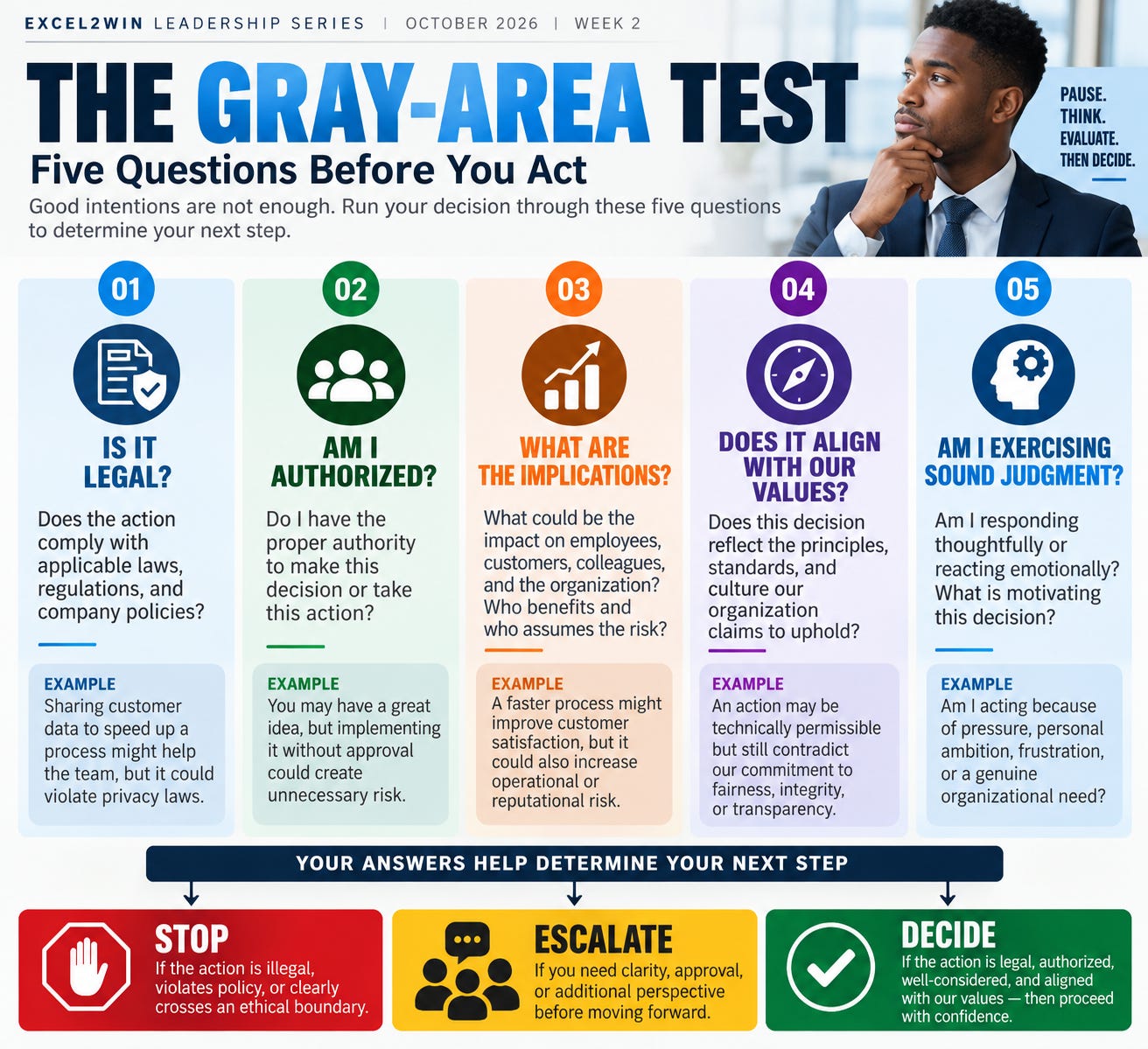
The Gray-Area Test: Five Questions Before You Act
When faced with a questionable decision, develop the discipline to pause and examine it through five important questions.
1. Is it legal?
Does the action comply with applicable laws, regulations, and company policies? If not, stop. Good intentions never excuse disregarding legitimate requirements.
2. Am I authorized?
A great idea doesn’t automatically mean you have the authority to implement it. Understand your responsibilities and obtain appropriate approval before moving forward.
3. What are the implications?
Consider the impact on employees, customers, colleagues, and the organization. Ask yourself who benefits, who assumes the risk, and what could happen if your assumptions are wrong.
4. Does it align with our values?
An action can appear technically permissible while contradicting the principles your organization claims to uphold. Evaluate whether the decision reflects fairness, integrity, and professional responsibility.
5. Am I exercising sound judgment?
Are you responding thoughtfully or reacting emotionally? Are you motivated by organizational success, personal ambition, frustration, or pressure from others?
Your answers should help determine whether to proceed, seek clarification, escalate concerns, or stop altogether.
Develop the Discipline to Know When to Act
Throughout your career, you’ll identify opportunities to improve procedures, strengthen operations, and challenge outdated thinking.
That’s a good thing. Organizations need professionals who recognize possibilities others overlook.
But recognizing an opportunity and knowing when to pursue it are two different leadership skills.
Instead of rushing to implement every promising idea, invest in developing your ability to communicate persuasively, ask thoughtful questions, present convincing recommendations, and demonstrate patience and self-control.
These skills let you influence decisions without overstepping boundaries.
Ask yourself: Am I responding to a genuine organizational need, or am I pursuing an opportunity simply because I see it?
Another: If someone questioned this decision tomorrow, could I confidently explain both my reasoning and my process?
Leadership maturity isn’t measured by how quickly you take action. Sometimes it’s measured by how wisely you exercise restraint.
This Week’s Leadership Challenge
Within the next 24 hours, identify one decision you’ve been considering. Apply the five questions before acting, and determine whether your next step should be action, clarification, or a conversation with someone who can provide additional perspective.
Remember that young employee whose career nearly ended on my first day?
His story reminds us that a leader’s judgment can influence far more than today’s performance numbers. It can shape someone’s future.
Just because you have the opportunity to make a decision doesn’t mean you’ve earned the right to make it without thoughtful consideration.
Make decisions you can defend, not simply decisions you can execute.
Next Week: We’ll explore how leaders PROVE their credibility by consistently aligning their actions with their commitments.

What if the biggest obstacle to ethical leadership isn’t dishonesty, but our inability to recognize when we’re making the wrong decision?
In Blind Spots, Max H. Bazerman and Ann E. Tenbrunsel explore a fascinating truth: good people sometimes make questionable decisions without realizing they’ve compromised their values.
Through compelling research and real-world corporate scandals, the authors reveal how unconscious biases, organizational pressures, and self-interest can quietly influence our judgment. They introduce the concept of ethical fading, where the moral implications of a decision gradually disappear behind business objectives and personal justifications.
Perhaps the book’s most valuable lesson is the difference between the person we believe we’ll be when facing an ethical dilemma and the person we actually become under pressure.
This connects beautifully with our EXCEL2WIN article, “But It’s the Right Thing to Do.” Is It? Both challenge us to recognize that leadership requires more than good intentions. It demands awareness, courage, and thoughtful judgment.
Ready to strengthen your ethical leadership? Purchase Blind Spots and discover how to make wiser, more principled decisions. Subscribe to The EXCEL2WIN Leadership Newsletter for practical insights that help you lead with confidence and integrity