“Time is what we want most, but what we use worst.” — William Penn.
Picture this. You start the week with a perfectly planned calendar. Your meetings are blocked. Your task list is organized. Your reminders are set. You feel responsible, focused, and ready.
Then Monday happens.
By 10:30 a.m., your inbox has already hijacked your attention. By noon, you have sat through two meetings that drained the life out of you. By 3:00 p.m., the task that required your best thinking is still untouched because your mind feels like it is running on fumes.
Technically, you had the time. But you did not have the energy.
Last week, we challenged the lie of hustle culture, the idea that constant grind is the surest path to success. This June series is about building resilience, energy, and sustainable success so you can lead with strength without slowly burning yourself out.
That brings us to this week’s leadership tension.
Most people think productivity is about managing time better. But in reality, time management without energy management simply creates a more organized path to exhaustion. Hello?
You can block the hours, color-code the calendar, and download every productivity app known to mankind, but if your energy is depleted, your output will still suffer. Leadership does not only require availability. It requires presence, clarity, emotional steadiness, and focused execution.
The Real Leadership Problem
Time is fixed. Energy is flexible.
You get the same 24 hours as everyone else, but you do not bring the same level of energy to every hour. Some hours are sharp. Some are sluggish. Some are creative. Some are reactive. Some are useful for deep thinking. Others are better suited for routine tasks that do not require your best mental horsepower.
Think of it this way: time is the container, but energy is the fuel. A full calendar with an empty tank is not leadership discipline. It is slow-motion burnout dressed up as responsibility.
This matters because leadership is not just about doing more. It is about doing what matters with enough clarity and strength to make it count. Your best contribution rarely comes from your busiest moments. It often comes from your most focused, rested, and intentional ones.
You cannot consistently lead well from a depleted place.
Protect Your Peak Energy Hours
One of the smartest things you can do is identify when you naturally think, decide, and create best. For some people, that is early morning. For others, it is late afternoon or evening. The issue is not when your peak energy happens. The issue is whether you protect it.
Too many professionals give their best energy to low-value noise and then try to do meaningful work with leftover focus. That is backward.
Your highest-energy hours should be reserved for your highest-value work. Strategy. Writing. Problem-solving. Planning. Decision-making. Difficult conversations. Anything that requires wisdom, creativity, and judgment deserves your best attention, not your emotional leftovers.
Start paying attention this week. When do you feel sharpest? When do you feel most easily distracted? When do meetings drain you most? When do you recover fastest?
That awareness is not soft. It is strategic.
Stop Treating Every Task the Same
Not all work carries the same weight, and not all tasks require the same energy.
Responding to basic emails does not require the same mental strength as preparing for a high-stakes presentation. Updating a spreadsheet does not require the same emotional discipline as giving corrective feedback to a team member. Yet many people treat every task as if it belongs in the same bucket.
That is how leaders quietly wear themselves out.
Group your work by energy demand, not just urgency. Put deep work in one category. Put administrative work in another. Put relationally demanding conversations in another. Then schedule accordingly.
If you know a tough conversation will drain you, do not stack it between three intense meetings and expect yourself to perform like a machine. You are not a machine. You are a person with limits, rhythms, and responsibilities.
Strong leaders respect their capacity before their capacity starts making decisions for them.
Build Recovery Into the Workday
Many professionals wait until they are exhausted to rest. That is like waiting until your phone hits 1% before looking for a charger. Technically possible, but not exactly genius-level planning.
Recovery does not always require a vacation. Sometimes it requires five minutes away from the screen. A short walk. A quiet lunch. A few minutes to breathe before the next meeting. A clean break between demanding tasks.
The goal is not laziness. The goal is renewal.
Small recovery moments protect your judgment. They help you respond instead of react. They keep one stressful moment from poisoning the rest of your day. And for leaders, that matters because your energy is contagious.
If you are tense, scattered, and irritated, people feel it. If you are calm, focused, and grounded, people feel that too.
Your presence sets a temperature in the room.
Watch What Drains You Repeatedly
Some energy drains are unavoidable. Work has pressure. People have problems. Deadlines are real. Welcome to adulthood, right?
But some drains are patterns you need to address.
Maybe you keep saying yes too quickly. Maybe you are carrying work that should be delegated to someone else. Maybe you check messages constantly and call it responsiveness. Maybe you keep ignoring sleep, nutrition, movement, or spiritual grounding and wonder why your motivation is running thin.
Leadership requires honesty. You cannot fix what you keep excusing.
Ask yourself: What consistently drains me that I have the power to change? What gives me the energy that I need to protect more intentionally?
Those questions may reveal more than any other time management system ever could.
Lead From a Full Tank
Managing time helps you organize your responsibilities. Managing energy helps you sustain your leadership.
You need both, but energy deserves more attention than most professionals give it. Because the goal is not simply to get through the day. The goal is to bring your best self to the work that matters, the people who need you, and the future you are trying to build.
So this week, do not just ask, “Do I have time for this?”
Ask, “Do I have the right energy for this?”
That one question can change how you plan, how you lead, and how long you last. Sustainable success is not built by constantly running harder. It is built by learning when to push, when to pause, and how to protect the energy required for meaningful impact.
Next week, we will continue the June series by looking at Leading Through Stress, Uncertainty, and Change — because sustainable leadership is not only about managing your own energy, but also learning how to stay steady when the environment around you is anything but steady.
Until then, protect your energy like leadership depends on it.
Because it does.
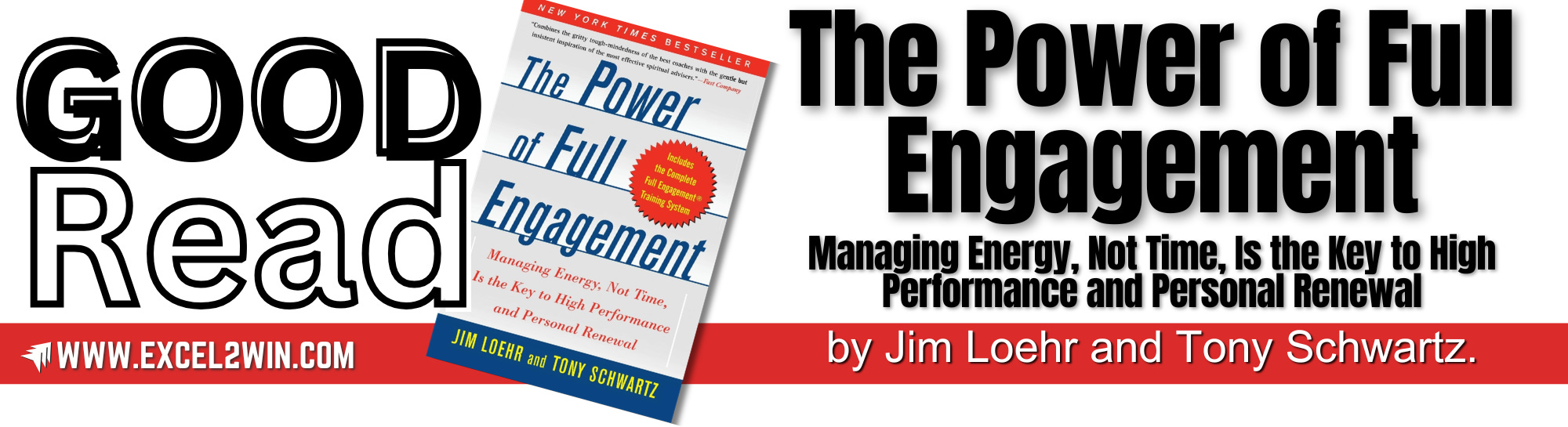
The Power of Full Engagement: Managing Energy, Not Time, Is the Key to High Performance and Personal Renewal
If this week’s article challenged us to rethink productivity, The Power of Full Engagement gives us the deeper framework behind that shift. Jim Loehr and Tony Schwartz make a powerful case that high performance is not built by squeezing more hours out of the day, but by managing the energy we bring into those hours.
The book explains that energy is not one-dimensional. It includes physical energy, emotional strength, mental focus, and a deeper sense of purpose. When one area is neglected, performance eventually suffers. That is why a full calendar can still leave you ineffective if your tank is empty.
This connects directly to the article’s core message: leadership is not just about having time available; it is about showing up with clarity, focus, and steadiness. The book also reinforces the importance of recovery, reminding readers that renewal is not laziness—it is part of sustainable excellence.
For young professionals trying to grow without burning out, this book is practical, honest, and timely. It challenges you to stop managing your schedule only and start managing yourself wisely.
Purchase The Power of Full Engagement today, and subscribe to The EXCEL2WIN Leadership Newsletter for weekly leadership insights that help you grow with purpose, focus, and resilience.