


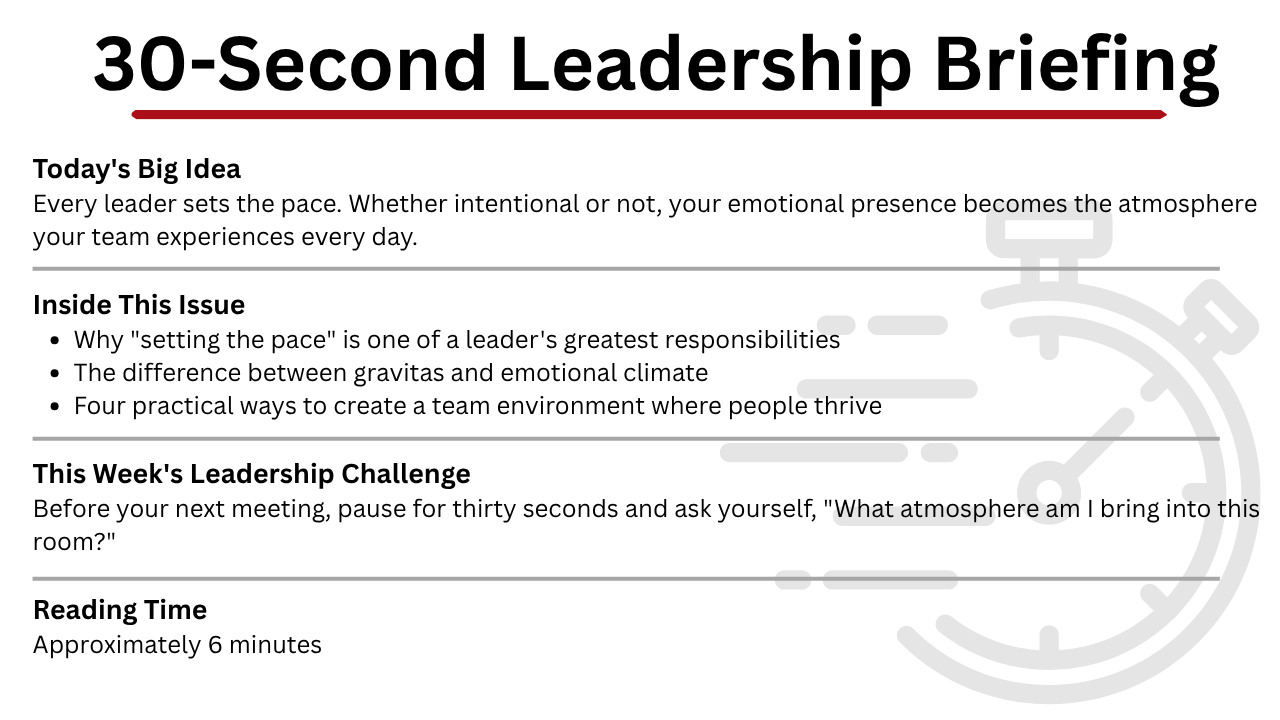

“The speed of the leader determines the rate of the pack.” Old leadership proverb
Last week we talked about trust.
Trust is where leadership begins.
But trust alone isn’t enough.
Once people trust you, they begin responding to something even more influential.
The atmosphere you create every time you walk into the room.
Before we go any further, I want to make an important distinction.
Nearly three years ago, I wrote about Gravitas: The Silent Power of Leadership. Gravitas is about your personal presence. It is the confidence, composure, and credibility people see in you as a leader.
This week’s conversation is different.
Emotional climate isn’t about how people see you.
It’s about how people experience working with you.
Great leaders need both.
One earns respect.
The other shapes culture.
Think of it this way. Gravitas determines how people perceive your leadership. Emotional climate determines how people experience your leadership. One builds confidence in the leader. The other builds confidence within the team. Exceptional leaders intentionally develop both.
A Lesson From My Father That Never Left Me
When I was a young teenager, my father pastored a small church.
One day he said something that has stayed with me for the rest of my life.
“A leader sets the pace.”
At the time, I thought he meant working harder than everyone else.
Years later, I realized he meant something much deeper.
People look to the leader to determine what’s normal.
If the leader remains calm during uncertainty…
Calm spreads.
If the leader approaches people with optimism and respect…
People begin treating one another the same way.
If the leader complains, reacts emotionally, or becomes unpredictable…
That spreads just as quickly.
Every leader sets a pace.
The question isn’t whether you’re influencing your team.
The question is what kind of pace you’re setting.
Whether we intend it or not, people take emotional cues from us every single day.
That simple lesson followed me throughout more than forty-five years of leadership in the banking industry.
It shaped how I wanted to lead people.
The Promise I Made to Myself
Early in my leadership career, I made a promise to myself.
My employees would never have to wonder which version of me was coming to work today.
Did I have difficult days?
Absolutely.
Did I become frustrated from time to time?
Of course.
Leaders are human.
But those moments were exceptions, not my leadership style.
I wanted my managers and employees to experience consistency.
Predictability.
Steadiness.
Because consistency creates emotional security.
People can handle difficult decisions.
They struggle with inconsistent leadership.
Reality Check
Most people think mission statements, employee engagement programs, or company values create culture.
In reality…
Culture is created by the emotional environment leaders establish every single day.
Hello?
That’s why two departments inside the same company can feel completely different.
Same Company. Different Worlds.
Throughout my career, I watched this happen more times than I can count.
I saw managers whose departments were upbeat, collaborative, and focused.
People enjoyed coming to work.
Problems were solved together.
Energy was contagious.
You could feel it the moment you walked onto the floor.
I also saw managers whose teams operated on pins and needles.
Employees spent more time trying to determine what kind of mood their manager was in than focusing on serving customers.
Questions went unasked.
Ideas remained unspoken.
Initiative slowly disappeared.
Here’s what fascinated me.
Same company.
Same policies.
Same performance expectations.
The difference wasn’t the corporate culture.
The difference was the leader.
Every leader was setting a pace.
Every pace was creating an emotional climate.
Culture isn’t something leaders announce.
It’s something leaders demonstrate every single day.
Leadership Isn’t About Having Followers
I’ve often said something that has guided my philosophy for decades.
You can’t lead if no one is following.
People don’t follow because of titles.
People follow because they believe in the vision and trust the person leading them there.
People may accept your authority, but they choose whether they’ll follow your influence.
That’s why emotional climate matters so much.
People naturally move toward environments where they feel respected, encouraged, challenged, and valued.
The leader sets that environment.
Every single day.
Four Habits That Shape Healthy Emotional Climate
Be emotionally dependable.
Your team shouldn’t have to guess who is walking through the door this morning.
Steady leadership creates confident people.
Recognize people consistently.
Recognition doesn’t require awards.
Often, a sincere observation carries far greater influence than public applause.
Respond before reacting.
Pressure doesn’t create character.
It reveals it.
When problems arise, pause.
Ask questions.
Lead the conversation instead of your emotions.
Protect your team’s energy.
Not every stressful situation can be avoided.
Many unnecessary frustrations can.
Remove confusion.
Clarify priorities.
Celebrate progress.
Small actions create healthier environments.
Leadership Truth
Great leaders aren’t emotionally perfect.
They’re emotionally consistent.
That consistency becomes emotional dependability.
There is a difference.
Your team doesn’t expect perfection.
They do need consistency.
Reflection
If your team described the atmosphere you create in three words, what would those words be?
Does your leadership consistently leave people feeling stronger or more uncertain after interacting with you?
This Week’s Leadership Challenge
Within the next twenty-four hours, intentionally set the pace.
Walk into every conversation intentionally setting the pace you want others to follow.
Recognize one person’s contribution.
Choose one difficult moment to respond thoughtfully instead of reacting emotionally.
Then pay attention.
Watch how your attitude begins influencing the people around you.
Small moments don’t just build trust.
They shape culture.
Leadership Resource of the Week
As you work through this week’s challenge, keep the EXCEL2WIN Leadership Trust Framework nearby. Notice how the journey intentionally progresses from Trust to Emotional Climate, because once trust is established, the environment you create determines whether people flourish or merely function. Use the Daily Leadership Check-In and ask yourself the question printed in the framework: “Did I improve the emotional climate today?”

This Month’s Leadership Journey
Trust → Emotional Climate → Motivation → Healthy Conflict → Psychological Safety
You’re here: Emotional Climate.
Every week builds on the previous one. This month’s journey is designed to help you intentionally strengthen the culture you create as a leader.
Next Week
Next Monday we’ll explore why great leaders inspire people beyond money, promotions, and job titles.
Once trust exists and the emotional climate is healthy, motivation becomes something leaders cultivate rather than manufacture.
People stop working because they have to.
They begin contributing because they want to.
Join the Conversation
Who was the leader that set the best pace for your life or career?
What did they consistently do that made you want to follow them?
Because every leader sets a pace…and every team eventually follows it.

Primal Leadership
By Daniel Goleman, Richard Boyatzis & Annie McKee
What separates leaders who merely manage people from those who genuinely inspire them? Primal Leadership answers that question by revealing one powerful truth: leadership begins with emotions. Drawing on decades of research in emotional intelligence, Daniel Goleman, Richard Boyatzis, and Annie McKee demonstrate that a leader’s mood, attitude, and behavior ripple throughout an organization, influencing morale, collaboration, decision-making, and ultimately, performance.
The authors introduce the concept of resonant leadership, explaining that the most effective leaders intentionally create environments where people feel valued, motivated, and empowered to do their best work. Rather than relying solely on authority, they lead with self-awareness, empathy, authenticity, and emotional consistency. These qualities not only strengthen relationships but also foster healthier, more resilient teams.
This message aligns perfectly with this week’s EXCEL2WIN article, “Every Leader Sets the Pace.” While the article explores how leaders establish the emotional climate of their teams through everyday actions, Primal Leadership provides the research and practical framework behind that timeless principle. Together, they remind us that people rarely separate a leader’s emotional presence from the culture they experience each day.
If you’re ready to become the kind of leader people genuinely want to follow, add Primal Leadership to your reading list today. Then subscribe to the EXCEL2WIN Leadership Newsletter for practical leadership insights, weekly challenges, and resources designed to help you lead with greater influence, purpose, and excellence


.