
“Your presence speaks before you do.” — Unknown.
Have you ever noticed how some professionals walk into a room and immediately command attention?
They’re not always the loudest.
They don’t always have the most experience.
But there’s something about how they carry themselves that signals confidence, clarity, and credibility.
That “something” is called executive presence.
This article is part of our March series focused on confidence, presence, and executive mindset. Last week, we explored how to overcome imposter syndrome without overcompensating, learning how to build confidence through contribution rather than constant self-proving.
Now, we take the next step: how that confidence shows up externally.
It’s not enough to feel confident; you also need to project it so others can see and trust you.
In fact, I explored this topic back in September 2023 in an article titled “Command the Room: Elevate Your Leadership with Executive Presence.” It’s worth revisiting because executive presence remains one of the biggest differentiators and challenges for emerging leaders in corporate America.
The good news? Executive presence is not reserved for senior executives.
It’s a skill you can develop starting today.
What Is Executive Presence, Really?
Executive presence is often misunderstood.
Many people assume it’s about charisma, appearance, or personality. But at its core, executive presence is about how others experience your leadership.
It’s the combination of:
How you communicate
How you carry yourself
How you make decisions.
How you respond under pressure
When these elements align, people naturally trust your leadership.
Executive presence answers a silent question others are always asking:
“Can I rely on this person?”
Clarity Builds Credibility
One of the fastest ways to strengthen executive presence is through clear communication.
Emerging professionals often feel the need to over-explain to prove their knowledge. But this can dilute your message.
Strong leaders do the opposite.
They simplify.
Instead of speaking in long, complex explanations, they focus on:
The key point
The priority
The next step
For example, instead of giving a detailed background, a leader might say:
“Here’s where we are. Here’s what matters most. Here’s what we’re doing next.”
Clarity signals confidence.
And confidence builds credibility.
Composure Creates Confidence
Executive presence is tested most during pressure.
When challenges arise, people don’t just listen to your words—they observe your reactions.
Do you stay steady?
Do you communicate calmly?
Do you focus on solutions?
As we discussed earlier in this series, calm communication is a leadership advantage.
When you maintain composure in difficult moments, you create stability for others.
And stability builds trust.
Body Language Speaks First
Before you say a single word, your body language is already communicating.
Executive presence shows up in simple behaviors like:
Standing or sitting with intention
Making eye contact
Speaking at a measured pace
Avoiding rushed or distracted movements
These signals may seem small, but they shape how others perceive your confidence and professionalism.
You don’t need to be perfect.
But you do need to be intentional.
Listen Like a Leader
One of the most underrated aspects of executive presence is active listening.
Many emerging professionals believe they need to speak more to be seen as leaders.
But strong leaders know when to speak—and when to listen.
Listening demonstrates:
Respect for others’ ideas
Confidence in your own voice
The ability to gather insight before acting
When you listen well, your words carry more weight when you do speak.
Consistency Builds Trust
Executive presence isn’t built in a single meeting.
It’s built over time through consistent behavior.
People begin to trust leaders who:
Show up prepared
Follow through on commitments.
Communicate clearly and respectfully.
Maintain professionalism in all situations.
Consistency creates reliability.
And reliability is the foundation of leadership credibility.
You Don’t Need the Title to Show the Presence
One of the biggest misconceptions about executive presence is that it comes with seniority.
It doesn’t.
You can demonstrate executive presence at any level by:
Speaking with clarity
Staying composed under pressure
Contributing thoughtful ideas
Listening with intention
Following through consistently
These behaviors signal leadership potential long before a title does.
And often, they are the very behaviors that lead to that next opportunity.
Showing Up Like a Leader Before the Title
Executive presence is not about pretending to be someone you’re not.
It’s about becoming more intentional in how you show up.
It’s about aligning your communication, mindset, and behavior with the leader you are becoming.
As you continue developing your leadership journey, remember this:
People may not remember every word you say.
But they will remember how you showed up.
Next week, we’ll wrap up this March series by tackling one of the most challenging aspects of leadership: decision-making when you don’t have all the answers.
We’ll explore how to balance confidence with uncertainty and make thoughtful decisions even when the path isn’t fully clear.
Until then, focus on one simple question:
How can I show up with greater clarity, composure, and confidence today?
If you found this article valuable, consider subscribing to the EXCEL2WIN Leadership Newsletter for more practical insights designed to help you grow your leadership presence, confidence, and career impact—long before the title arrives.
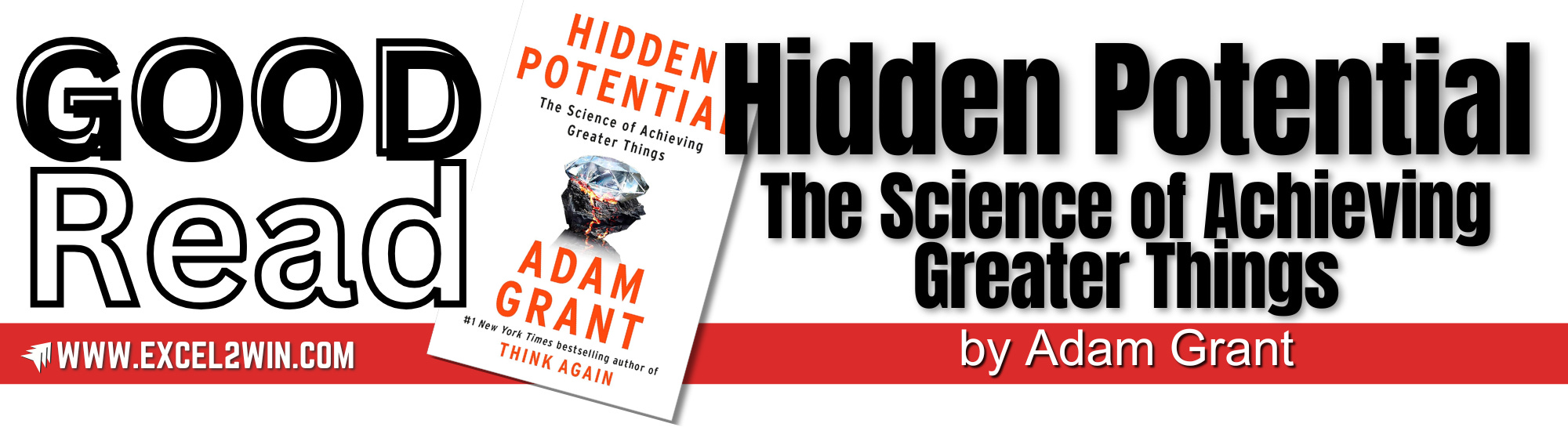
Hidden Potential: The Science of Achieving Greater Things
What if success isn’t about talent—but about how you grow?
In Hidden Potential: The Science of Achieving Greater Things, Adam Grant challenges the belief that only the naturally gifted rise to the top. Instead, he shows that growth is built through effort, character, and the willingness to learn over time. This book is packed with practical insights on how to develop confidence, improve communication, and unlock abilities you may not even realize you have yet.
Grant introduces the idea that potential isn’t fixed—it’s expandable. Through real-world examples and research, he highlights how small, consistent actions—like seeking feedback, embracing discomfort, and staying curious—lead to meaningful progress. It’s a powerful reminder that leadership is not about perfection, but about continuous development.
This message connects directly to our article on “Executive Presence for Emerging Leaders.” Executive presence isn’t something you’re born with—it’s something you build through intentional habits, clear communication, and steady growth. As Grant reinforces, confidence grows when you focus on progress, not comparison.
If you’re ready to elevate your mindset and step into your full potential, this book is a must-read. Consider adding Hidden Potential by Adam Grant to your reading list, and subscribe to the EXCEL2WIN Leadership Newsletter for more insights to help you grow, lead, and show up with confidence every day.