
“The best time to solve a problem is often before everyone agrees there is one.”
Years ago, while leading a call center operation, I noticed something changing. Our productivity and results were declining. Nothing catastrophic had happened yet, but the numbers were moving in the wrong direction.
It would have been easy to push harder: increase accountability, remind everyone of expectations, and demand better numbers.
Instead, I brought my managers together, and we started listening to random employee calls.
What we discovered changed our response entirely.
The Numbers Were a Warning, Not the Problem
Many representatives were letting customers off the hook too easily. But as we listened more closely, we realized they weren’t necessarily putting in the effort. They often didn’t know what to say when customers presented certain objections or difficult circumstances.
So instead of simply demanding better performance, we strengthened their ability to perform.
We provided refresher training on probing questions, fact-finding techniques, rebuttal phrasing, empathy, and working with customers toward solutions.
The result? Productivity and performance improved approximately 5% to 15%. But something else improved too: morale and engagement.
People were more confident because they had better tools.
Leadership Truth
Sometimes declining performance isn’t the problem. It’s the warning light telling you where to look.
That’s what ANTICIPATE, the second step in our EXCEL2WIN Strategic Leadership Framework, is about: noticing patterns, risks, opportunities, and potential problems before they demand your attention.
Week 1 challenged you to SEE beyond the task. This week, we’re taking the next step: What do you see coming?
Want to put this into practice? The EXCEL2WIN Strategic Leadership Framework is available as a FREE download. It includes a practical Strategic Leadership Check-In designed to help you move through SEE → ANTICIPATE → CHOOSE → ALIGN, including two questions especially relevant this week:
What problem, risk, or opportunity can I see developing?
What could I do now instead of reacting later?
Reality Check: Firefighting Can Feel Like Leadership
Earlier in my career, one of my managers came to me with a problem. As we discussed it, he finally said something I’ll never forget:
“You’re just better and quicker at resolving this problem. That’s why I’m coming to you.”
My first reaction could have been pride.
Instead, I thought, My gosh, I’ve become a human crutch.
I was so good at solving problems that I was unintentionally teaching my managers to bring their problems to me rather than developing their ability to solve them.
Most people think being indispensable proves their leadership value. But if everything stops when you’re unavailable, you haven’t built leadership capacity. You’ve built dependency.
That realization changed how I led.
Stop Giving the Answer
From then on, I expected managers to bring me a problem and one or two possible solutions.
Explain the problem. Tell me what may be causing it. Then tell me what you think we should do.
And if you’re completely stumped? Bring me a wild, harebrained idea.
Seriously.
I wasn’t looking for perfection. I wanted evidence that they were thinking.
Often, managers would arrive with two pieces of the puzzle, and I might contribute a third. Other times, while preparing their options, they discovered they already knew how to solve the problem.
My role shifted from answer-giver to thinking partner.
Their confidence grew because they knew I had their backs, but they also knew I believed they were capable of figuring things out.
Think Beyond Today’s Problem
Think of it this way. When your child asks, “Dad, what’s two plus two?” you can immediately answer “four.”
Problem solved.
Or you can take a little longer and teach the child how to work through the problem.
One approach answers today’s question. The other prepares someone for tomorrow’s.
That’s leadership.
So when the next problem lands on your desk, resist the urge to fix it immediately. Ask:
What is this telling me? What might happen next? And who needs to learn how to solve this besides me?
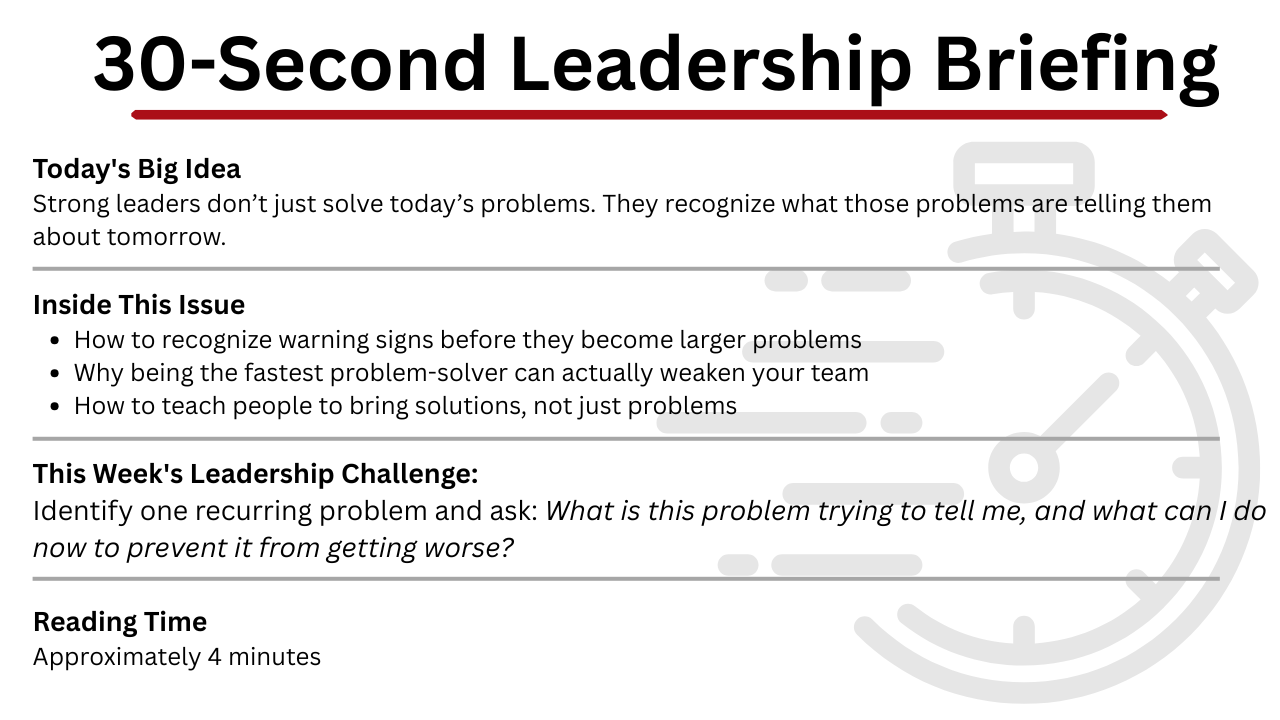
The September Blueprint challenges us to move from reacting to what shows up toward thinking ahead. You don’t need a senior title to begin practicing that behavior.
Leadership Challenge
Within the next 24 hours, identify one recurring problem you normally fix yourself. Instead of fixing it again, involve someone else and ask them to bring you two possible solutions.
You may discover you’re surrounded by more problem-solvers than you realized. They need the opportunity to think.
Next Week
Anticipating problems creates another challenge: once you see everything demanding attention, how do you decide what actually matters? Next week, we’ll tackle Prioritization When Everything Feels Important.
Join the Conversation
Have you ever realized that your ability to solve problems was unintentionally preventing someone else from learning how to solve them?


Upstream By Dan Heath
Why are we so good at solving problems after they happen, yet so slow to prevent them in the first place?
In Upstream: The Quest to Solve Problems Before They Happen, Dan Heath explores how individuals and organizations can move beyond constant firefighting and start addressing problems earlier. Through engaging real-world examples, Heath examines why we often become accustomed to recurring problems, how organizational systems can make prevention difficult, and what it takes to recognize warning signs before they become emergencies.
That message connects beautifully with this week’s EXCEL2WIN focus on moving from reactive to proactive leadership. When I saw call-center performance declining, the answer wasn’t simply to demand better numbers. We listened to calls, identified what employees were struggling with, and gave them better tools. We moved closer to the source of the problem.
Upstream challenges you to develop that same instinct. Instead of repeatedly asking, “How do we fix this?”, learn to ask, “How can we keep this from happening again?”
If you lead people, manage processes, or simply want to become a better strategic thinker, Upstream deserves a place on your reading list.
Purchase Upstream by Dan Heath, then subscribe to the EXCEL2WIN Leadership Newsletter for practical weekly insights designed to help you think, lead, and grow at the next level

.