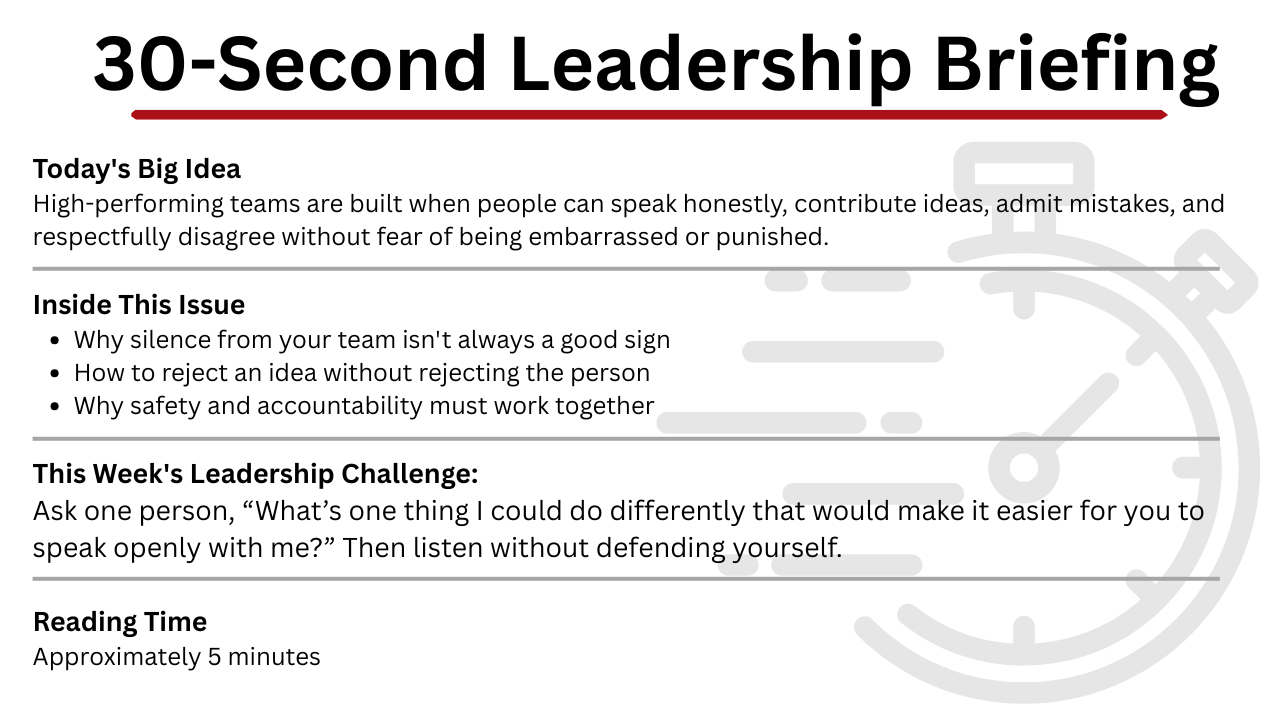

“The leader’s job isn’t always to have the best idea in the room. Sometimes it’s recognizing the pieces of the best idea scattered around the room.” — JMM
Years ago, I sat in a meeting where we were trying to understand why performance had declined. One manager suggested that economic conditions in California might be contributing to the problem.
Another manager I was mentoring immediately responded, “What a stupid idea.”
The room changed.
The person who offered the suggestion shut down. But something more important happened: everyone else learned a lesson.
Be careful what you say around here.
Afterward, I pulled the manager aside. I explained that whether the suggestion was right or wrong wasn’t the issue. If you embarrass people for offering ideas you don’t like, they’ll eventually stop offering ideas altogether.
Fortunately, he listened. He changed. And over time, he became a very good leader of people.
When Silence Becomes Expensive
Leadership researchers use the term psychological safety. Let’s make that simple.
Psychological safety means people know they can speak up without being punished, embarrassed, or belittled.
They can ask a question. Offer an idea. Admit a mistake. Say, “I don’t understand.” Respectfully disagree with you. Or tell you something you may not want to hear.
That’s it.
And after everything we’ve discussed this month about trust, emotional climate, motivation, and healthy conflict, these leadership behaviors come together.
The real test of trust is whether your people trust you enough to tell you the truth.
Reality Check: You Don’t Have to Use Every Idea
Most people think creating a safe environment means accepting everyone’s suggestions. But in reality, some ideas won’t work.
I’ve heard plenty of suggestions throughout my career that weren’t practical, appropriate, or possible. That’s leadership.
But you can reject an idea without rejecting the person.
Instead of “That makes no sense,” try:
“I see what you’re trying to solve. We can’t go that direction because of X, but there’s something in what you said worth exploring.”
Sometimes an employee doesn’t have the entire answer. They may have 10 percent of it. Someone else contributes another piece. Suddenly, you’re seeing a solution nobody walked into the room possessing.
Your job isn’t to prove you’re the smartest person in the room. Your job is to get the best thinking out of the room.
Give People Room Without Abandoning Them
I grew up professionally hearing, “No news is good news.”
I’m not so sure.
Employees need autonomy, but autonomy and abandonment aren’t the same thing.
Good leaders create checkpoints. They ask where things stand, clarify direction, remove obstacles, and then let people run.
That isn’t micromanagement when done correctly. It’s giving someone enough guidance to move confidently without constantly looking over their shoulder.
Think of it this way: good checkpoints create confidence without creating dependency.
Let Them Stumble, But Know When to Step In
Employees have told me, “Get out of the way.” “Let me do my job.” “Hear me out.” And one of the most important: “Allow me to make mistakes.”
They’re right. Mostly.
If you’ve ever watched a child learn to ride a bicycle, you understand the tension. Eventually you have to loosen your grip and let them balance.
Leadership works similarly, except some workplace mistakes carry consequences you cannot responsibly ignore.
A recoverable mistake may become a tremendous coaching opportunity. A mistake involving serious financial, customer, compliance, safety, or reputational consequences may require intervention.
The goal isn’t to prevent every wobble.
Give people room to stumble, but don’t knowingly let them drive the organization over a cliff.
Psychological safety doesn’t remove accountability. It removes unnecessary fear.
Leadership Truth
This entire month has really been about one thing: creating teams people want to be part of.
Trust taught people they could depend on you.
Your emotional presence shaped what it felt like to work around you.
Purpose gave people a reason to care.
Healthy conflict taught them they could disagree without becoming divided.
And now we arrive here: people feel safe enough to contribute what they know, what they see, what they question, and sometimes what you don’t want to hear.
That’s when leadership begins unlocking performance.
Not because everyone agrees.
Not because mistakes disappear.
Not because the workplace suddenly becomes comfortable.
But because people stop spending energy protecting themselves and start investing that energy in the mission.
Two Questions Worth Asking Yourself
When was the last time someone on your team respectfully told you that you might be wrong?
And when someone brings you a bad idea, a mistake, or uncomfortable feedback, does your response make them more likely or less likely to speak next time?
Those answers tell you more about your leadership environment than another employee survey ever could.
This Week’s Leadership Challenge
Within the next 24 hours, choose one person and ask:
“What’s one thing I could do differently that would make it easier for you to speak openly with me?”
Then comes the difficult part.
Don’t explain. Don’t correct their perception. Don’t defend yourself.
Listen.
Thank them.
And consider what they told you.
Leadership Resource of the Week
This week, revisit the EXCEL2WIN Leadership Trust Framework, our practical companion to this month’s Leading Teams & Building Culture series.
Use the final leadership check-in and scorecard to evaluate the environment you’re creating for the people you lead. Remember, strong cultures aren’t built through one grand leadership moment. They’re built through small, consistent actions that help people feel trusted, valued, heard, and safe enough to contribute.
The EXCEL2WIN Leadership Trust Framework is available as a FREE download. See the button below.

Join the Conversation
What makes you feel safe enough to tell a leader something they may not want to hear?
August began with a simple question: Do your people trust you?
Perhaps the better question to end with is this:
Do they trust you enough to tell you the truth?
Because when people are no longer afraid to speak, you stop leading alone.
And that’s when a group of people can truly become a team
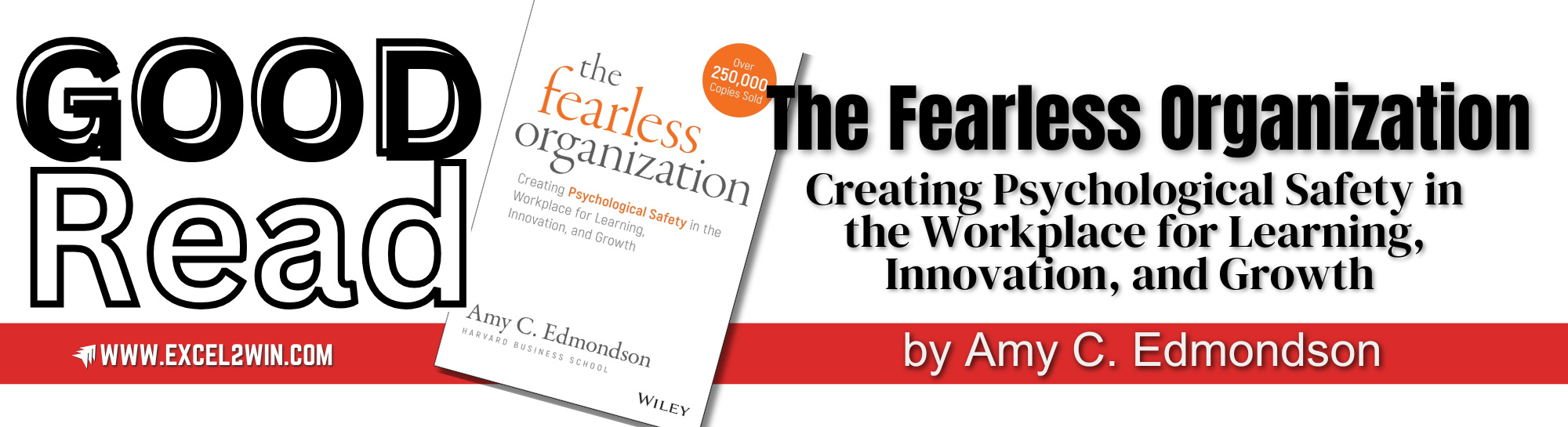
The Fearless Organization
What happens when talented people see problems, question decisions, or have potentially great ideas but decide it is safer to remain silent?
In The Fearless Organization, Harvard Business School professor Amy C. Edmondson explores why psychological safety is essential to learning, innovation, collaboration, and strong performance. In practical terms, it means creating a workplace where people can speak up, ask questions, acknowledge mistakes, and challenge assumptions without fearing humiliation or retaliation.
Edmondson makes an important distinction: psychological safety is not about being nice, lowering expectations, or avoiding accountability. High-performing teams need both candor and high standards. Leaders create the conditions for that combination by responding constructively when employees raise concerns, admit uncertainty, or offer ideas that may not ultimately be used.
That connects directly with this week’s EXCEL2WIN message: you can reject an idea without rejecting the person. When leaders ridicule contributions, people eventually stop contributing. When leaders make honest conversation safe, they gain access to perspectives they could never generate alone.
The Fearless Organization is a valuable read for anyone who wants to build a team where people have the courage to contribute, learn, and perform.
Purchase The Fearless Organization today, and subscribe to the EXCEL2WIN Leadership Newsletter for practical leadership insights that help you lead, grow, and excel.