
“Leadership is not about being in charge. It is about taking care of those in your charge.” (Simon Sinek)
There comes a moment in every young professional’s life when the environment shifts faster than their confidence can keep up.
The company reorganizes. A manager leaves. Priorities change overnight. A project that once looked stable suddenly becomes urgent, confusing, and politically delicate. People start whispering in corners, meetings get longer, emails get sharper, and everyone is looking around wondering, “What now?”
This June series has been challenging a dangerous idea: that success comes from constant pressure, nonstop hustle, and running yourself into the ground. We have already looked at why hustle culture is failing leaders and why managing your energy matters more than simply managing your calendar.
Now we take the next step: learning how to lead when stress rises, uncertainty grows, and change refuses to ask for permission.
That is when leadership becomes real.
Not when everything is calm. Not when the plan is clear. Not when everyone agrees, and the numbers are moving in the right direction. Leadership shows up when pressure enters the room, and people need someone steady enough to think clearly, speak honestly, and move wisely.
The Pressure Test of Leadership
Stress, uncertainty, and change have a way of exposing what is underneath the surface.
They reveal whether you lead from discipline or emotion. They reveal whether your confidence is rooted in preparation or just favorable conditions. They reveal whether people trust you because of your title or because of your steadiness.
Most people think leadership under pressure means having all the answers. But in reality, people do not always need you to have all the answers immediately. They need to know you are not falling apart while you are looking for one.
That is a major difference.
A leader who panics multiplies fear. A leader who pretends everything is fine loses credibility. But a leader who stays calm, tells the truth, and keeps people focused becomes an anchor.
You do not have to be loud to be strong. You have to be steady.
Reality Check: Change Is Not the Enemy
Here is the part many professionals resist: change is not the problem. Your lack of preparation for change is often the problem. Hello?
That may sound direct, but it is true.
Change is part of every career. Markets shift. Technology advances. Leadership changes. Teams evolve. Customers expect more. The workplace you entered will not be the same workplace you lead in five years from now.
If your leadership only works when life is predictable, then your leadership is too fragile.
Think of it this way: stress is not just something to survive. It is something that trains you. It teaches you where your emotional leaks are. It shows you where your systems are weak. It exposes where you need more maturity, wisdom, patience, and courage.
The goal is not to become untouched by pressure. The goal is to become trustworthy under pressure.
First, Slow Down Your Reaction
When uncertainty hits, your first responsibility is not to fix everything immediately. Your first responsibility is to manage yourself.
That means slowing down your reactions before they become your leadership style.
Take a breath before responding to the sharp email. Ask one more question before assuming the worst. Step back before making a decision just to relieve discomfort. Pressure often pushes leaders to move quickly, but wisdom often requires a pause.
This is not weakness. This is discipline.
A young leader who cannot manage their own reaction will eventually transfer their anxiety to the team. And once anxiety becomes contagious, clarity becomes expensive.
Before you lead the room, lead yourself.
Second, Communicate With Clarity, Not Drama
In stressful seasons, people do not need long speeches filled with corporate fog. They need clear communication.
Tell people what is known, what is not known, what is being worked on, and what the next step is. That simple framework can lower anxiety because it gives people something solid to stand on.
You do not have to overexplain. You do not have to pretend to be certain where certainty does not exist. In fact, one of the most mature things a leader can say is, “Here is what we know right now, here is what we are still working through, and here is what we need to focus on today.”
That kind of communication builds trust.
Drama drains people. Clarity directs people.
Third, Keep the Team Focused on Controllables
Uncertainty tempts people to obsess over things they cannot control.
Who is leaving? What will leadership decide? Will the budget change? What if the project fails? What if the strategy shifts again?
Some of those questions may be fair, but living there too long creates paralysis.
Your job as a leader is to redirect attention toward what can be controlled: preparation, communication, quality of work, responsiveness, attitude, teamwork, and execution.
You cannot control every decision above you. You can control how prepared your team is when the decision comes.
You cannot control every change in the marketplace. You can control whether you keep learning, adapting, and improving.
You cannot control every stressful moment. You can control whether you become careless, bitter, reactive, or disciplined.
That is where leadership maturity is built.
Fourth, Adapt Without Losing Your Core
Adaptability does not mean abandoning your values every time circumstances shift.
It means adjusting your methods while staying grounded in your principles.
There is a difference between being flexible and being unstable. Flexible leaders can change direction without losing identity. Unstable leaders change their personality depending on the pressure in the room.
Know what does not move.
Integrity does not move. Respect does not move. Accountability does not move. Excellence does not move. Faith, character, and humility should not move either.
Your strategy may shift. Your timeline may change. Your role may evolve. But your core must stay anchored.
When people see that you can adapt without compromising who you are, they begin to trust your leadership more deeply.
Reflection for the Leader in Development
Ask yourself honestly: When pressure rises, do people experience you as a calming presence or another source of stress?
And here is another one: What part of your leadership needs to mature so you can handle uncertainty with more wisdom and less reaction?
These are not comfortable questions, but they are necessary ones.
Because the next level of leadership will not only require more skill. It will require more steadiness.
Lead Like an Anchor
Stress, uncertainty, and change are not interruptions to your leadership journey. They are part of the training ground.
Anyone can look confident when the road is smooth. The real test comes when the map changes, the room gets tense, and people are watching how you carry yourself.
So do not waste the pressure.
Let it sharpen your judgment. Let it deepen your patience. Let it strengthen your emotional discipline. Let it teach you to communicate honestly and lead with courage.
You may not control the storm, but you can decide whether you become another wave or an anchor.
Choose anchor.
And next week, we will take this even deeper by looking at mental toughness without emotional shutdown, because strong leadership does not mean becoming cold, distant, or disconnected. It means learning how to stay resilient and remain human at the same time

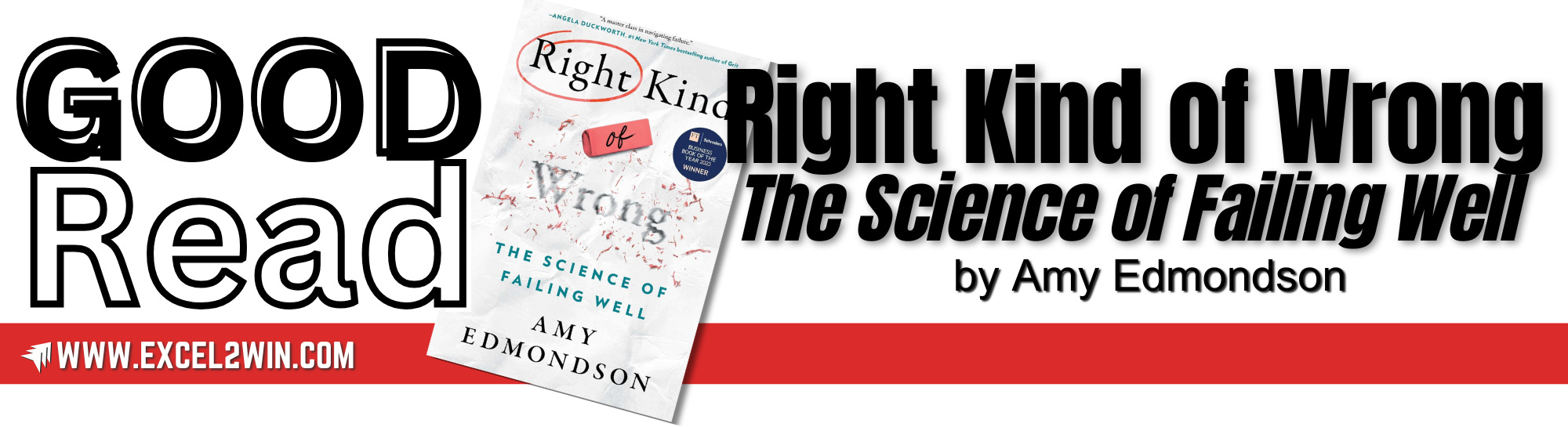
Right Kind of Wrong
Most professionals spend their careers trying to avoid mistakes. Amy Edmondson’s Right Kind of Wrong challenges that thinking and offers a refreshing perspective: not all failures are bad. In fact, some failures are necessary if you want to grow, innovate, and lead effectively.
Drawing on decades of research and real-world examples, Edmondson explains that there are different types of failures. Some are preventable and should be avoided. Others occur in complex situations where outcomes are uncertain. Then there are what she calls “intelligent failures”—well-planned efforts that don’t succeed but provide valuable learning and insight. These are often the failures that lead to breakthroughs.
This message connects perfectly with this week’s EXCEL2WIN article, Leading Through Stress, Uncertainty, and Change. When leaders face uncertainty, they often feel pressure to have all the answers. But effective leadership is not about perfection. It’s about staying calm, learning quickly, adapting wisely, and helping others move forward even when the path isn’t completely clear.
Edmondson reminds us that growth rarely happens inside our comfort zone. The leaders who thrive in today’s fast-changing workplace are those who are willing to experiment, learn, and improve rather than fear every mistake.
If you’re navigating change, leading a team, building a career, or simply trying to become more resilient, Right Kind of Wrong offers practical wisdom that can help you turn setbacks into stepping stones.
Pick up a copy of Right Kind of Wrong by Amy Edmondson and discover how learning from the right failures can accelerate your growth and leadership. For more practical leadership insights, subscribe to the EXCEL2WIN Leadership Newsletter