
“Doubt kills more dreams than failure ever will.” — Suzy Kassem.
Early in many careers, there’s a quiet voice that shows up during important moments.
It might appear before a presentation, during a leadership meeting, or right after receiving a new opportunity.
The voice whispers things like:
“Do I really belong here?”
“What if they discover I’m not as capable as they think?”
“Maybe I just got lucky.”
This experience has a name: imposter syndrome.
And if you’ve felt it before, you’re not alone. Many high-performing professionals experience it, especially during periods of growth or new responsibility.
This article is part of our March series focused on confidence, presence, and executive mindset. In last week’s article, we discussed how leaders communicate calm under pressure and how steady communication builds trust during stressful moments.
But before leaders can communicate calm externally, many must first address the doubts happening internally.
Because the truth is, self-doubt often travels quietly with success.
A Challenge Facing Emerging Leaders
Imposter syndrome tends to appear when professionals step into new territory.
A promotion.
A bigger project.
A leadership opportunity.
Instead of celebrating progress, many professionals begin questioning their worth.
Ironically, this challenge is especially common among high-achieving individuals who care deeply about doing their work well.
In July 2024, I wrote a series called “Unmasking the Imposter Within.” The response from readers made something clear: imposter syndrome remains one of the most persistent internal challenges for rising leaders in corporate America.
Many professionals feel pressured to constantly prove themselves.
They worry about making mistakes.
They compare themselves to others.
They feel the need to demonstrate their value in every conversation.
But this constant pressure to prove yourself can create a different problem: overcompensation.
When Self-Doubt Leads to Overcompensation
When professionals feel like impostors, they sometimes try to cover that feeling by pushing too hard in the opposite direction.
This might look like:
Overworking to prove competence
Talking more than listening in meetings
Avoiding asking questions for fear of appearing inexperienced
Taking on too many responsibilities to demonstrate value
On the surface, these behaviors may appear productive.
But over time, they can lead to burnout, strained collaboration, and unnecessary stress.
Strong leadership doesn’t require pretending to know everything.
In fact, the most respected leaders are often those who balance confidence with humility.
They know their value but remain open to learning.
Reframing What Growth Actually Looks Like
One reason imposter syndrome appears so often is that people misunderstand what growth looks like.
Growth rarely feels comfortable.
When you step into a bigger role or take on a new challenge, feeling uncertain is not a sign that you don’t belong.
It’s a sign you’re learning.
Think about the first time you drove a car, led a meeting, or managed a project.
The experience likely felt awkward at first.
But with repetition, preparation, and feedback, confidence grew.
Leadership development works the same way.
Instead of interpreting discomfort as evidence that you’re unqualified, consider a different perspective:
Discomfort is often evidence of expansion.
Replace Comparison with Contribution
Another driver of imposter syndrome is constant comparison.
In the workplace, it’s easy to look around and assume everyone else is more experienced, more knowledgeable, or more confident.
But comparison distorts reality.
You see other people’s strengths while magnifying your own insecurities.
Instead of asking, “How do I measure up to everyone else?” a more helpful question is:
“How can I contribute value in this situation?”
Contribution shifts your focus from personal validation to collective progress.
And leaders who focus on contribution naturally build credibility.
Confidence Doesn’t Require Perfection
One of the most liberating realizations for emerging leaders is this:
Confidence does not require perfection.
Every professional, regardless of title, is still learning.
Even experienced executives encounter new challenges, unfamiliar situations, and decisions that require thoughtful consideration.
What separates confident leaders is not flawless performance. It’s their willingness to engage, learn, and adapt. They ask thoughtful questions. They seek input from others. They acknowledge when they need additional perspective. These behaviors don’t weaken credibility. They strengthen it.
Build Evidence, Not Ego
The most sustainable way to overcome imposter syndrome is not through self-promotion or forced confidence.
It’s through evidence.
Every time you solve a problem, contribute an idea, support a team member, or complete a project, you create proof of your capability.
These experiences gradually replace doubt with clarity.
Confidence built on evidence is far stronger than confidence built on appearance.
Instead of trying to silence self-doubt completely, focus on building a record of progress.
Small wins accumulate into lasting belief.
Showing Up Like a Leader Before the Title
Leadership presence isn’t defined by how loudly someone promotes themselves.
It’s revealed through thoughtful contribution, steady learning, and a willingness to grow.
Imposter syndrome may appear from time to time. That’s normal.
But it doesn’t have to control your decisions or limit your potential.
As you continue developing your leadership mindset, remember that growth and doubt often travel together.
The key is choosing progress over perfection.
Next week, we’ll continue this March series by exploring another critical leadership skill: executive presence.
We’ll break down the practical behaviors that help emerging leaders project confidence, credibility, and professionalism—even before they hold senior titles.
Until then, remember this: the goal isn’t to prove that you belong.
The goal is to continue growing into the leader you are becoming.
If you found value in this article, consider subscribing to the EXCEL2WIN Leadership Newsletter for more insights designed to help you grow your confidence, leadership mindset, and professional impact.
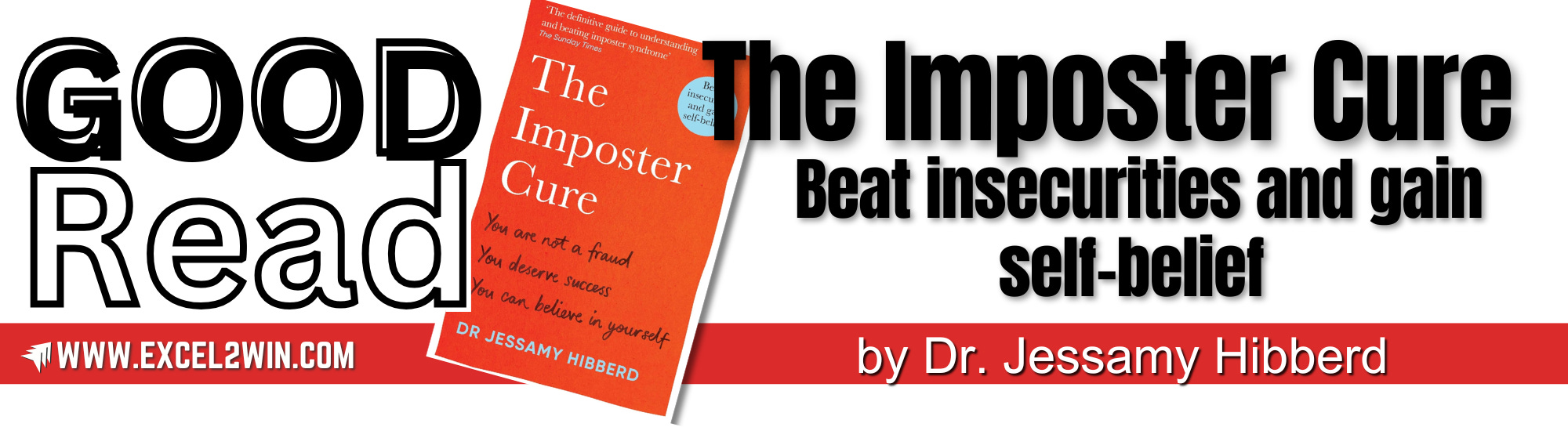
The Imposter Cure: Beat Insecurities and Gain Self-Belief
Self-doubt has a way of showing up at the exact moments when opportunity appears. A promotion, a leadership role, or a chance to present your ideas can suddenly trigger that quiet inner voice asking, “Do I really belong here?” In The Imposter Cure: Beat Insecurities and Gain Self-Belief, psychologist Dr. Jessamy Hibberd tackles this challenge head-on with practical insights that help professionals break the cycle of imposter thinking.
Hibberd explains that imposter syndrome is not a sign of incompetence—it’s often a reflection of high standards, perfectionism, and the pressure many professionals place on themselves. Through relatable examples and actionable strategies, she guides readers to recognize negative thought patterns, replace comparison with self-awareness, and develop confidence grounded in evidence rather than constant self-criticism.
This message aligns closely with our recent article on “Overcoming Imposter Syndrome Without Overcompensating.” Many emerging leaders feel pressure to prove themselves by overworking or taking on too much. Hibberd reminds us that real confidence isn’t about pretending to know everything—it’s about understanding your value while continuing to grow.
If you’ve ever questioned whether you truly deserve your success, this book offers a powerful mindset shift. Consider adding The Imposter Cure to your leadership reading list, and subscribe to the EXCEL2WIN Leadership Newsletter for more insights to help you build confidence, grow your leadership mindset, and show up like a leader long before the title arrives.