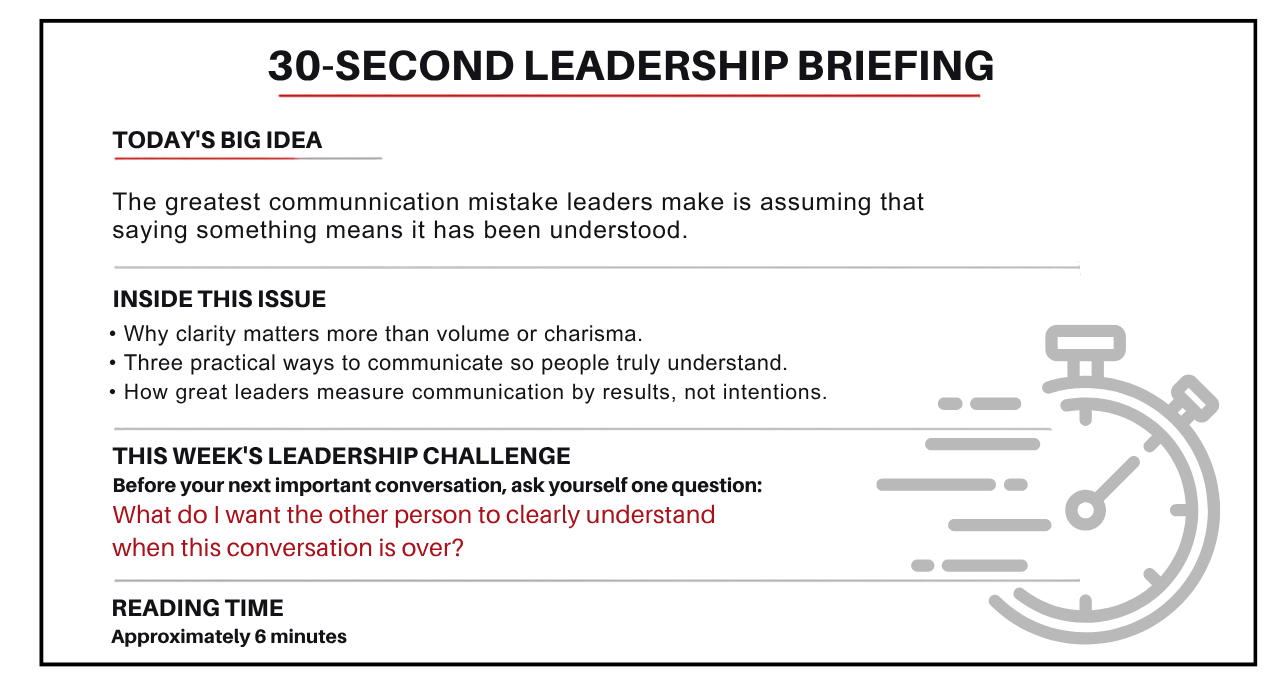

“The single biggest problem in communication is the illusion that it has taken place.” — Stephen R. Covey
Imagine finishing a team meeting feeling confident that everyone knows exactly what needs to happen next. You leave energized, expecting momentum.
Two days later, the deadlines have been missed. Priorities are misunderstood. Team members are moving in different directions. Frustration begins to replace confidence.
What happened?
Most leaders immediately assume people weren’t paying attention.
But what if the problem wasn’t their listening?
What if the problem was our communication?
That question isn’t always comfortable, but it is where leadership growth begins.
Leadership Truth
People rarely become confused because leaders communicate too little.
They become confused because leaders communicate without enough clarity.
Most of us have experienced this. We explain something that seems perfectly clear in our own minds. We nod as others nod. We assume agreement equals understanding.
Then reality proves otherwise.
Communication isn’t successful when words leave your mouth.
It’s successful when your message arrives in someone else’s understanding.
That is a very different standard.
Reality Check
Many professionals believe communication is about speaking well.
In reality, leadership communication is about creating shared understanding.
Those are not the same thing.
A polished presentation means very little if people leave with different interpretations.
An inspiring speech accomplishes little if no one knows what to do next.
Great leaders don’t measure communication by how well they present their ideas.
They measure it by whether people understood them well enough to act.
Hello?
That single shift changes everything.
Three Practices That Immediately Improve Communication
1. Replace Assumptions with Specificity
Vague communication creates unnecessary work.
Consider the difference between these two statements:
“Let’s get this done soon.”
Versus…
“I’d like the first draft completed by Thursday afternoon so we can review it together Friday morning.”
The second message removes guesswork.
Specificity isn’t micromanagement.
It is leadership.
When expectations become clear, confidence grows because people know what success actually looks like.
2. Communicate for Understanding, Not Completion
Too many conversations end the moment we’ve finished talking.
Effective leaders continue until they know understanding exists.
Instead of asking, “Does everyone understand?”
Try asking,
“What are your next steps?”
Or,
“What concerns do you see before we move forward?”
Those questions reveal far more than a room full of silent nods.
People often hesitate to admit confusion.
Good leaders create opportunities for clarity before confusion becomes costly.
Think of it this way.
Your responsibility isn’t merely to deliver information.
Your responsibility is to transfer understanding.
That is a completely different objective.
3. Match Your Message to the Moment
Even the right message can fail when delivered at the wrong time.
Giving constructive feedback while someone is emotionally overwhelmed rarely produces growth.
Announcing major organizational changes without allowing questions often creates anxiety rather than alignment.
Communication always has two parts.
What you say.
And when you say it.
Wise leaders pay attention to both.
Sometimes timing communicates as loudly as words.
Leadership Truth
Clarity builds trust because clarity removes uncertainty.
Confusion quietly erodes both.
People don’t expect leaders to have every answer.
They do expect leaders to communicate honestly, consistently, and clearly.
That credibility compounds over time.
Reflection Questions
As you think about your own leadership, consider these questions:
When people misunderstand me, do I automatically assume they weren’t listening?
Or do I first examine whether I communicated clearly enough to be understood?
And where in my leadership could greater clarity eliminate unnecessary confusion this week?
Those questions require humility.
They also produce tremendous growth.
Leadership Challenge
During your next meeting or conversation, don’t end by asking, “Any questions?”
Instead, ask someone to summarize the agreed-upon next steps in their own words.
You’ll quickly discover whether your communication produced understanding or simply polite agreement.
That one habit can dramatically improve meetings, projects, and relationships.
Closing Thoughts
Every conversation leaves something behind.
It either creates clarity or confusion.
It either strengthens trust or weakens it.
It either moves people forward or leaves them wondering what comes next.
The most influential leaders understand that communication is never about proving how much they know.
It is about helping others succeed because they clearly understand what matters most.
This week, slow down just enough to make your message unmistakably clear.
You may discover that the greatest improvement in your leadership isn’t saying more.
It’s making sure people truly understand what you’ve already said.
Next Week
We’ll explore one of the most overlooked leadership skills of all: Listening as a Leadership Superpower. You’ll discover why the strongest communicators are often the leaders who speak the least and understand the most.
Join the Conversation
Think about a recent misunderstanding at work or in your personal life.
Looking back, was the problem really poor listening, or could greater clarity have changed the outcome?
I’d love to hear your thoughts.

Radical Candor: Be a Kick-Ass Boss Without Losing Your Humanity (Fully Revised & Updated Edition)
Leadership communication is about far more than delivering information. It’s about building trust, creating clarity, and helping people succeed. That’s exactly why Radical Candor by Kim Scott deserves a place on every leader’s bookshelf.
Scott introduces a refreshingly practical leadership philosophy built on two powerful principles: Care Personally and Challenge Directly. She demonstrates that effective leaders don’t avoid difficult conversations, nor do they hide behind vague feedback or empty encouragement. Instead, they communicate honestly while showing genuine respect and concern for the people they lead.
This message perfectly complements this week’s article, The #1 Communication Mistake Leaders Make (And How to Fix It Today). One of the greatest communication mistakes leaders make is assuming they’ve been understood simply because they’ve spoken. Scott reminds us that meaningful communication requires clarity, courage, empathy, and intentional follow-through. When leaders communicate with both honesty and humanity, they create workplaces where trust grows, expectations become clear, and people perform at their best.
If you want to become the kind of leader whose conversations inspire confidence instead of confusion, Radical Candor is an investment in your leadership that will continue paying dividends for years to come.
Ready to strengthen your leadership communication? Pick up your copy of Radical Candor today, and don’t forget to subscribe to the EXCEL2WIN Leadership Newsletter for weekly insights, practical tools, and leadership strategies designed to help you grow with confidence and purpose.