
“The future depends on what you do today.” — Mahatma Gandhi.
You’ve probably seen it happen. Maybe it’s even happened to you.
Someone on your team works harder than anyone else. They hit every deadline. They stay late. They deliver great results. Everyone agrees—they’re a high performer.
But months go by… then years.
And somehow, they’re still in the same role.
Meanwhile, someone else—who doesn’t seem as “busy”—gets promoted, leads projects, and starts gaining influence.
It can feel confusing. Even unfair.
But here’s the truth most people don’t talk about: performance alone doesn’t move your career forward. Strategy does.
Welcome to the April E2W series: Career Ownership & Strategic Growth—where we shift from working hard to working smart, from waiting to leading.
What This Month Is All About
This month is designed to help you take control of your career rather than hope someone notices your effort.
Each week builds on the last:
We start by understanding why high performers stall—and how leaders think differently.
Then we break down the difference between being busy and being strategic.
Next, we show how to build real influence, even without a title.
Finally, we teach you how to speak up for yourself with confidence and clarity.
By the end of the month, you won’t just be doing great work—you’ll be positioning yourself for real growth.
Let’s begin with the foundation.
Why High Performers Stall
High performers are valuable. They get things done. They solve problems. They’re reliable.
But here’s the hidden trap: when you become known only for execution, people stop seeing you as a leader.
You become the “go-to” person… but not the “next-up” person.
Why?
Because leadership isn’t just about doing the work. It’s about thinking beyond the work.
High performers often focus on:
Completing tasks
Meeting expectations
Staying busy
Leaders focus on:
Setting direction
Creating impact
Making decisions
If you stay in execution mode too long, you can get stuck there.
The Real Difference: Output vs. Ownership
Let’s simplify it.
High performers ask:
“What needs to get done?”
Leaders ask:
“What actually matters most—and why?”
That shift changes everything.
When you focus only on output, you’re reacting.
When you take ownership, you’re leading.
Ownership looks like:
Speaking up with ideas, not just updates
Seeing problems before they happen
Connecting your work to bigger goals
Taking responsibility for outcomes, not just tasks
It’s not about doing more. It’s about thinking differently.
Why Visibility Matters More Than You Think
Here’s a tough truth: if people don’t see your impact, it’s almost like it didn’t happen.
That doesn’t mean you need to brag. It means you need to communicate.
Many high performers stay quiet. They assume their work will speak for itself.
Sometimes it does. Often, it doesn’t.
Leaders make their work visible naturally. They:
Share progress clearly
Highlight results in team settings.
Connect wins to company goals.
Keep stakeholders informed
Visibility isn’t ego—it’s clarity.
It helps others understand your value.
The Shift from Worker to Leader
So how do you break out of the “high performer stall”?
It starts with three simple shifts.
1. Start Thinking Two Steps Ahead
Don’t just finish tasks—ask what comes next.
If you complete a project, think:
What could improve this?
What risk might show up later?
What opportunity are we missing?
Bring those thoughts forward. That’s leadership thinking.
2. Speak Up (Even When It Feels Uncomfortable)
You don’t need to have all the answers. But you do need to use your voice.
Try this:
Share one idea in your next meeting.
Ask one thoughtful question.
Offer one suggestion for improvement.
Small steps build confidence—and visibility.
3. Connect Your Work to the Bigger Picture
Leaders don’t just do tasks—they understand impact.
Instead of saying:
“I finished the report.”
Say:
“This report helps us spot trends that can improve our next campaign.”
Same work. Different levels of thinking.
A Real-World Example
Think about two employees:
One completes every assignment perfectly. Quiet. Reliable. Focused.
The other also delivers strong work—but adds ideas, asks questions, and shares insights.
When leadership looks for someone to promote, who do you think stands out?
It’s not about who works harder.
It’s about who shows they can think, lead, and grow.
Your Career Is Your Responsibility
This is the heart of the message.
No one will manage your career better than you.
Managers can support you. Mentors can guide you. But you have to take ownership.
That means:
Being intentional about your growth
Looking for opportunities to lead
Stepping outside your comfort zone
Waiting to be noticed is risky.
Positioning yourself is powerful.
Bringing It All Together
High performance is your foundation—but it’s not your finish line.
To grow, you need to:
Think strategically
Communicate your value
Take ownership of outcomes.
That’s how you move from being dependable… to being undeniable.
And this is just the beginning.
Next week, we’ll break down the difference between career hustle and career strategy—and why one leads to burnout while the other leads to growth.
Your Next Step
This week, don’t try to change everything.
Just do one thing differently:
Speak up once.
Share an idea. Ask a question. Offer a perspective.
It might feel small—but it’s the start of something bigger.
If you’re ready to take control of your career and grow with intention, subscribe to the EXCEL2WIN Leadership Newsletter for weekly insights, tools, and strategies designed to help you lead at the next level.
Your career won’t move by chance.
It moves when you do.
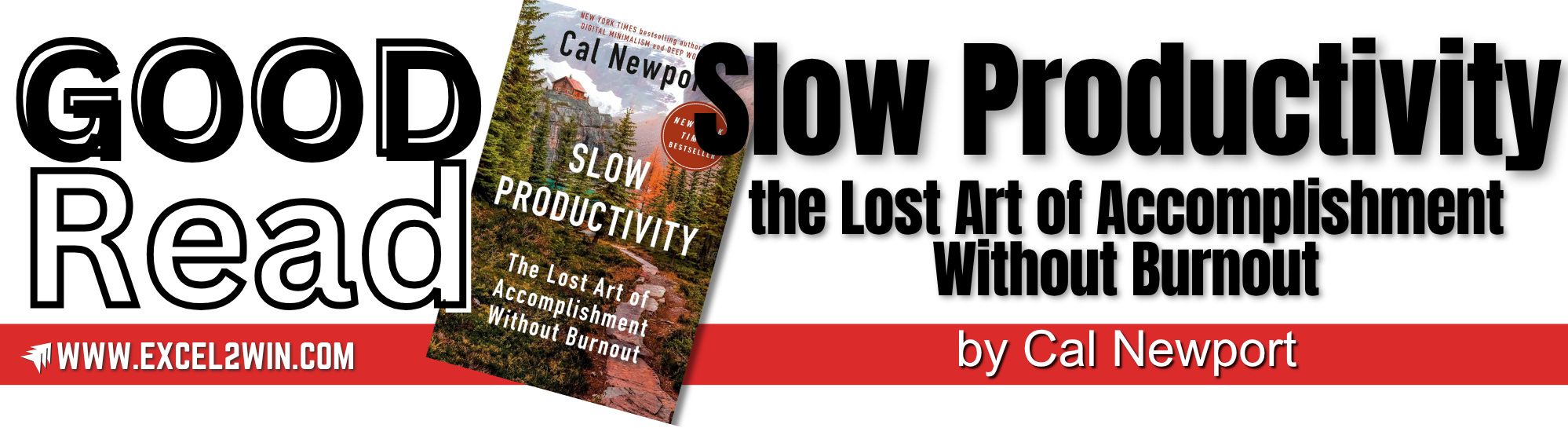
Slow Productivity
In a world that rewards constant motion, Slow Productivity by Cal Newport offers a refreshing truth: doing more isn’t the same as doing what matters.
Newport challenges the idea that success comes from being busy. Instead, he introduces a smarter path—focus on fewer tasks, work at a natural pace, and commit to quality over quantity. It’s not about slowing down out of laziness; it’s about working with intention. His approach helps you cut through noise, reduce burnout, and produce results that actually stand out.
This message connects directly to what we explored in Why High Performers Stall. Many professionals get stuck because they stay in constant execution mode—checking boxes but missing the bigger picture. Slow Productivity helps you break that cycle. It teaches you to step back, think strategically, and focus on meaningful impact instead of endless activity.
If you’ve ever felt overwhelmed, overlooked, or stuck despite working hard, this book gives you a new way forward—one rooted in clarity, purpose, and sustainable growth.
Ready to shift from busy to intentional? Grab your copy of Slow Productivity today and take the first step toward smarter success. And don’t forget to subscribe to the EXCEL2WIN Leadership Newsletter for more insights that help you lead and grow with purpose.