And to those observing Labor Day today, I hope you enjoy a well-earned moment to rest, reflect, and appreciate the value of the work you and others contribute every day.

“You can’t see the picture when you’re inside the frame.”
Years ago, I worked with a manager who was very good at getting things done. When something important needed to be handled, he jumped in and took care of it himself.
Maybe he believed nobody could do it quite as well as he could. Maybe he didn’t know his people well enough to trust the project to someone else. Whatever the reason, he became the person everyone depended on when something needed fixing.
And usually, he got it right.
There was just one problem.
He was always frustrated because he never had enough time.
When Getting It Done Gets in the Way
This manager spent so much time personally solving problems that he had little time left to lead.
He could make today’s problem disappear, but he rarely had the opportunity to step back and ask why the problem existed, why it kept returning, who else could handle it, or what needed to change so it wouldn’t require his attention next time.
Most people think being indispensable makes them a stronger leader. But in reality, if every problem requires you to become the solution personally, eventually you become part of the problem.
Hello?
This is where September’s EXCEL2WIN series, Strategic Thinking & Long-Term Vision, begins.
Not with strategic plans.
Not with five-year projections.
It begins by learning to SEE.
Reality Check: The Problem May Be Bigger Than the Task
A former boss once taught me that good leaders learn to see ahead, but great leaders learn to “see around the corner.”
That stayed with me.
You cannot see around the corner when your head is buried in today’s task list. You need enough distance from the work to recognize patterns, connections, risks, and opportunities.
Suppose a customer problem keeps appearing every Monday morning. You can resolve the complaint each week and feel productive.
But a strategic leader asks different questions.
Why does this happen every Monday? What happens upstream before the customer ever calls? Which process is breaking down? Who else is affected? What would prevent the problem instead of simply resolving it?
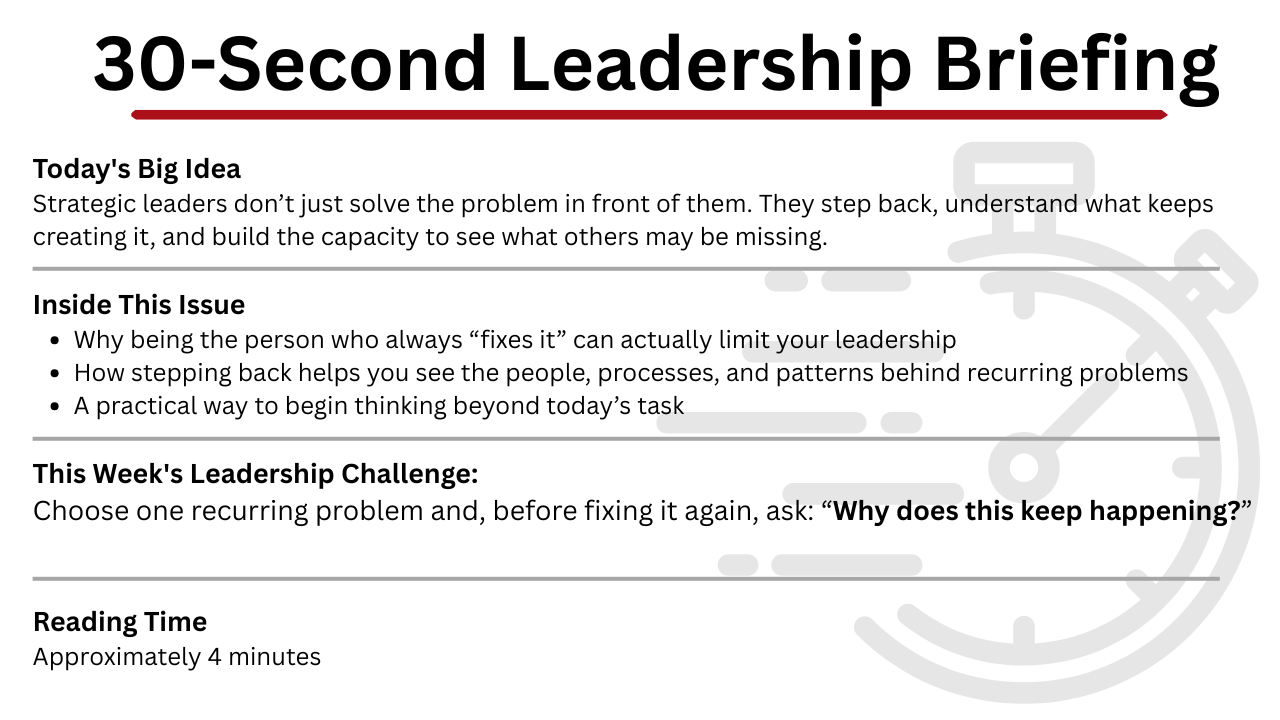
Strategic leadership isn’t just making the problem go away. It’s understanding why it keeps showing up.
Start With SEE
Our EXCEL2WIN Strategic Leadership Framework begins with SEE: Think Beyond the Task. It challenges you to look beyond what is immediately in front of you and understand how your work, decisions, people, processes, and outcomes connect.
Here are three ways to practice it this week.
1. Pause Before Fixing
When a problem lands on your desk, resist the temptation to jump into action immediately.
Ask, “What am I seeing here besides the obvious problem?”
Five thoughtful minutes before acting can save hours of repeatedly solving the wrong problem.
2. Look for the Connections
Think of it this way: tasks rarely live alone.
Ask who touches the work before you, who receives it after you, what decisions affect it, and what outcome it is supposed to produce.
You’re no longer looking at a task. You’re beginning to see a system.
3. Develop People, Not Dependence
Sometimes the system problem is us.
If you’re always the person doing the difficult work, ask whether you’re developing your team or unintentionally teaching them to depend on you.
Delegating appropriately doesn’t remove your responsibility. It expands your capacity to lead.
Put This Into Practice
Throughout September, we’ll use the EXCEL2WIN Strategic Leadership Framework: SEE → ANTICIPATE → CHOOSE → ALIGN to move from simply doing the work to thinking strategically about where that work is taking us.
I’ve created a FREE 2-page Strategic Leadership Framework you can download and use throughout the series. It includes practical questions for all four leadership moves plus a simple 15-minute Strategic Reset you can use each week.
Download it for free and keep it nearby. We’ll build on it together throughout September.
Leadership Challenge
Within the next 24 hours, identify one recurring problem you normally jump in and solve.
This time, pause.
Write down the people, processes, decisions, and outcomes connected to it. Then ask the question your task list rarely gives you time to consider:
“Why does this keep happening, and what would prevent me from having to solve it again?”
That’s the shift from doing to leading.
And once you begin seeing the bigger picture, you’ll be better prepared to see around the corner.
Next Week
We move from SEE to ANTICIPATE with From Reactive to Proactive Leadership. We’ll explore how leaders recognize problems, risks, and opportunities before they become tomorrow’s emergencies.
Join the Conversation
Where in your work are you repeatedly solving a problem that may actually need a system-level solution?


The Fifth Discipline: The Art & Practice of the Learning Organization
What if the problems your team keeps solving aren’t really separate problems at all?
In The Fifth Discipline, Peter M. Senge challenges leaders to look beyond individual events and understand the larger systems producing them. His central idea is that successful organizations must become learning organizations, places where people continually improve how they think, work together, and respond to change.
Senge explores five interconnected disciplines: personal mastery, mental models, shared vision, team learning, and systems thinking. Systems thinking, the “fifth discipline,” brings the others together by helping leaders recognize patterns, relationships, and consequences that may not be obvious when focusing only on today’s problem.
That makes this book an excellent companion to our EXCEL2WIN article, Why Leaders Must Think in Systems, Not Tasks. Remember the manager who continually solved problems himself? He completed the work, but rarely had enough time to step back and examine what kept creating those problems.
Senge pushes us toward that bigger view. Don’t just fix what happened. Learn to see what is causing it to happen.
If you want to strengthen your ability to SEE beyond the task and become a more strategic leader, consider adding The Fifth Discipline to your leadership library.
Purchase your copy today, and subscribe to the EXCEL2WIN Leadership Newsletter for practical insights that help you think, lead, and grow beyond the task