



“People rarely give their best simply because you pay them to work. They give their best when they believe their work matters.” — JMM
Think back to the last time you received a raise or promotion.
It felt good, didn’t it? Maybe you celebrated. You started imagining the new role or what you could do with the extra money.
Then something interesting happened.
The promotion became your job. The increased responsibilities became normal. And somehow that extra money found its way into the household budget. Before long, you were wondering, Where did that raise go?
I learned this early in my career. Raises, bonuses, promotions, and recognition matter. People deserve to be compensated fairly and recognized for good work.
But they create an emotional high that eventually becomes normal.
Purpose has a much longer shelf life.
The Motivation Question We Get Wrong
Most people think leaders motivate employees by adding something: another incentive, recognition program, promotion, contest, certificate, or bonus.
But in reality, leaders should also ask what they may be taking away.
Are people losing ownership? Are their ideas ignored? Has the work become disconnected from a meaningful goal? Have they stopped growing? Do they feel like another employee on the organizational chart rather than a contributor whose presence matters?
I’ve handed out plenty of certificates, accolades, awards, and recognition during my leadership career. They had value.
But eventually I learned something more important:
There is a tremendous difference between being on the team and being part of the team.
Being on the team means your name appears on the roster.
Being part of the team means your ideas matter. You’re invited into decisions. You understand the mission. Someone listens when you speak. You can see your contribution in the outcome.
That’s motivation money cannot buy.
Remember the Team With the “Mojo”?
Think back to childhood.
There was always that team everybody wanted to join. They were laughing, confident, excited, maybe talking a little trash. They had what we used to call mojo.
Then there was the other group. Shoulders down. Kicking the dirt. Looking defeated before the game even started.
Which team did you want?
Exactly.
We haven’t changed as much as we think.
People still want to belong to something alive, moving, and going somewhere.
And here’s where last week’s conversation about emotional climate becomes important: the leader is part of that atmosphere.
I’ve watched departments practically deflate because the leader lost direction, passion, or belief. It was as if someone stuck a pin in a balloon. Eventually the team’s energy followed.
A leader cannot sustainably ignite in others what has gone completely dark within themselves.
Leadership Truth: Motivation Is Something You Protect
Our EXCEL2WIN Leadership Trust Framework puts it simply: “Motivation isn’t something you install. It’s something you protect.” Leaders either multiply motivation or slowly drain it.
If you haven’t downloaded your free copy of the EXCEL2WIN Leadership Trust Framework, I’ve included the link below. Use it throughout August to follow our leadership journey and put each week’s principle into practice.
Earlier in my career, I developed a reputation for taking over so-called “bad teams.”
Some assumed turning them around meant I would clean house.
I didn’t.
Often, I discovered people who didn’t need replacing. They needed leadership.
I gave them direction. I listened. I coached and developed them. I corrected them firmly when necessary. I involved them. I showed them that I had their backs and that I genuinely cared about their success.
Accountability remained. Caring about people never means lowering the standard.
But slowly, something changed.
They began trusting me. Then they began believing in what we were building. Eventually, employees and even managers would request private meetings with me and ask:
“How can I get on your team?”
That became my motivation.
Three Ways to Give People a Reason to Care
1. Connect the assignment to the purpose.
Don’t simply tell someone what needs to be done. Explain who benefits, what changes when it’s done well, and how their contribution affects the larger goal.
2. Give people a voice before giving them instructions.
Instead of always saying, “Here’s what we’re going to do,” occasionally ask, “Here’s where we’re trying to go. How do you think we should get there?” Ownership changes when people help build the solution.
3. Help people see evidence of their growth.
Don’t wait for the annual review. Tell someone, “Six months ago, you needed help handling this. Today, you handled it yourself. That’s growth.” People become energized when they can see themselves becoming better.
Reality Check
This doesn’t mean everyone will become passionate about every assignment. And no leadership technique eliminates the importance of compensation, accountability, advancement, or performance expectations.
It means something simpler.
Stop asking only, “How do I motivate my people?”
Ask instead:
What am I giving them to believe in?
Do they have a meaningful place in what we’re building?
Those questions change leadership.
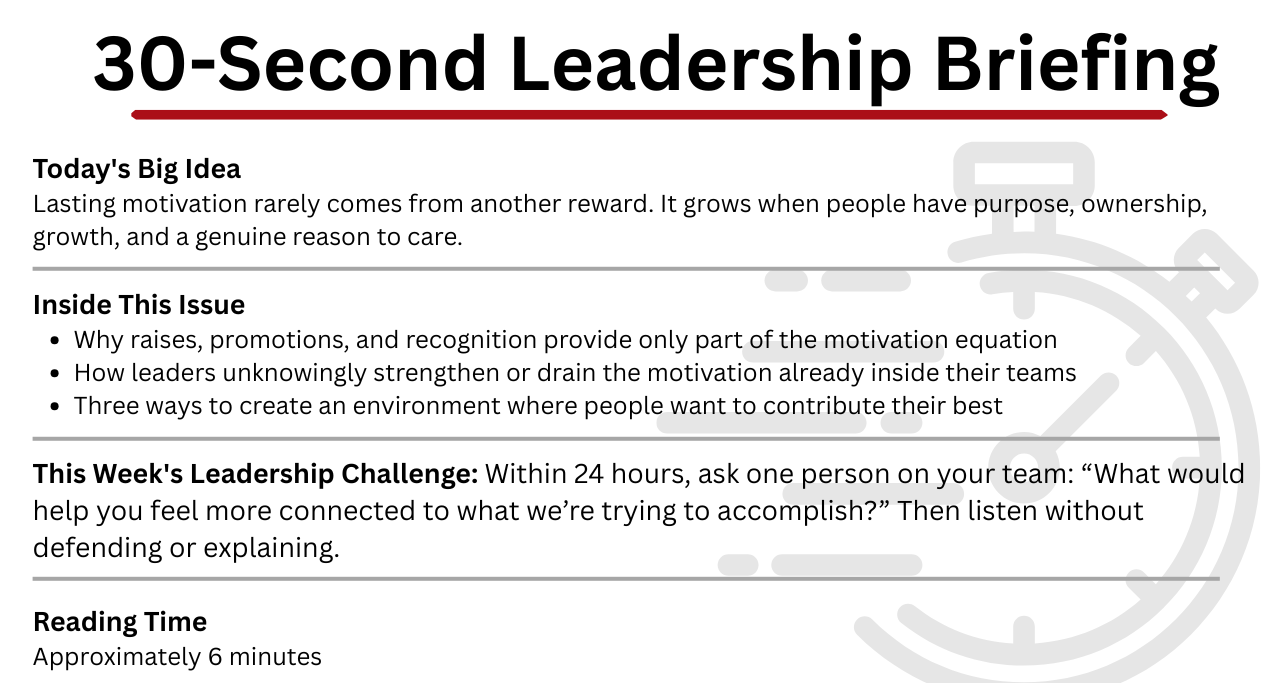
This Week’s Leadership Challenge
Within the next 24 hours, have one conversation with someone you lead.
Ask:
“What would help you feel more connected to what we’re trying to accomplish?”
Then don’t explain. Don’t defend. Don’t solve immediately.
Listen.
You may discover that the motivation you’ve been trying to create was already there. It simply needed room to breathe.
We began this month with trust. Last week, we examined the emotional climate you create. This week, we’re discovering what happens when trusted people are given something meaningful to contribute to.
And next week, things get interesting.
Because when people genuinely care, they develop opinions. They challenge ideas. They disagree.
The question becomes whether your team knows how to disagree without destroying the trust you’ve worked so hard to build.
That is where we’re headed next.
Join the Conversation: What has motivated you to give more than your job required: money, recognition, growth, belonging, purpose, or something else?


What really motivates people to do their best work?
In Drive: The Surprising Truth About What Motivates Us, Daniel H. Pink challenges the traditional assumption that better rewards automatically produce better performance. Drawing on decades of behavioral research, Pink argues that while external incentives have their place, lasting motivation is often driven by three deeper needs: autonomy, mastery, and purpose.
Autonomy gives us meaningful ownership over how we work. Mastery fuels our desire to improve and become better at something that matters. Purpose connects our effort to something larger than simply completing another task or collecting another paycheck.
That message fits beautifully with this week’s EXCEL2WIN conversation about motivation. Raises, promotions, bonuses, and recognition can certainly feel good, but their motivational impact often fades. People become deeply engaged when they believe their contribution matters, can see themselves growing, and feel they genuinely belong to what the team is building.
Drive will challenge you to reconsider an important leadership question. Instead of asking, “How can I motivate my people?” perhaps we should ask, “Am I creating an environment where people have reasons to motivate themselves?”
If you lead people, aspire to leadership, or simply want to better understand what fuels your own performance, Drive deserves a place on your reading list.
Purchase your copy of Drive today, and subscribe to The EXCEL2WIN Leadership Newsletter for practical leadership insights designed to help you grow, lead, and EXCEL2WIN


.