
“The aim of argument, or of discussion, should not be victory, but progress.” — Joseph Joubert
Earlier in my leadership career, I had a fairly simple philosophy: I’m the boss: my way or the highway.
It certainly made decision-making easier.
It didn’t always make leadership better.
Over time, I discovered that when I genuinely listened to my team’s ideas, concerns, and opposing viewpoints, something changed. People developed ownership. They had skin in the game. And when obstacles appeared, instead of standing back waiting for me to fix everything, we attacked the problem together.
That taught me a lesson I never forgot:
People fight harder for solutions they helped build.
When People Care, They Will Disagree
During the first three weeks of our August journey, we’ve talked about building trust, shaping the emotional climate, and giving people reasons to care about their work.
Now comes the test.
What happens when people who care deeply disagree deeply?
Most people think healthy teams are teams where everybody gets along. But in reality, healthy teams can challenge ideas, question decisions, and disagree without damaging relationships.
The problem isn’t conflict.
The problem is what we do with it.
Avoidance creates artificial peace. Aggression creates fearful compliance. Leadership creates productive conversation.
Reality Check: East or West?
I’ve sat in meetings where one person strongly believed we should go west while someone else was equally convinced we should go east.
When that happens, it’s easy for the discussion to become about personalities, positions, or who can make the strongest argument.
A leader has to change the conversation.
Before arguing about east or west, restate the destination.
Bring everyone back to the goals, objectives, customer needs, deadlines, or results you’re trying to achieve. Then let people make their case.
I often invited someone who strongly disagreed with the proposed direction to “pitch” their recommendation. Explain it. Defend it. Let the team ask questions.
Now we aren’t deciding whose idea wins.
We’re asking, which approach gives us the best opportunity to accomplish the objective?
That small shift can completely change the temperature of a disagreement.
1. Give People Room to Work It Out
Not every conflict requires the leader to become a referee.
When appropriate, give capable professionals room to resolve disagreements on their own. Constantly stepping in can unintentionally teach people that they cannot navigate difficult conversations without you.
But watch carefully.
If disagreement becomes personal, begins affecting performance, or starts damaging relationships, leadership intervention is no longer optional.
Sometimes that means pulling people aside privately, hearing each perspective, and helping them work toward an amicable solution.
Your job isn’t always to provide the answer.
Sometimes your job is to help people discover it together.
2. Lower the Temperature, Not the Standard
Ideally, heated disagreements would always come with a convenient “Let’s sleep on it and talk tomorrow.”
Leadership rarely gives us that luxury.
Sometimes a decision must be made now.
When emotions rise, slow the conversation even when you cannot delay the decision. Restate what you agree on. Clarify the objective. Ask questions; separate assumptions from facts.
You don’t have to lower the standard just because you need to lower the temperature.
3. Accept That You May Know More Than You Can Say
Here’s something young leaders eventually discover: sometimes you have information your team doesn’t have.
And sometimes you cannot share it.
That makes leadership difficult.
You can listen carefully to an employee’s argument and recognize that, based on what they know, their recommendation makes perfect sense. Yet you may have additional information that calls for a different direction.
You still have to decide.
Leadership does not require unanimous agreement. It requires enough trust to move forward when agreement isn’t possible.
You can respectfully acknowledge the disagreement, explain what you can, make the decision, and accept responsibility for it.
That’s very different from “my way or the highway.”
4. Keep the Door Open
One practice served me particularly well: when someone was passionate about an idea I didn’t choose, I often invited them to come back and re-pitch it.
Why?
Because making a decision doesn’t mean I suddenly became incapable of being wrong.
New information may surface. Conditions may change. Or the employee may return with a stronger argument.
Strong leaders don’t attach their identity to winning every disagreement.
They attach themselves to achieving the best outcome.
Leadership Truth
The EXCEL2WIN Leadership Trust Framework reminds us that healthy teams disagree while unsafe teams remain silent. It encourages leaders to invite different perspectives, address issues early, and seek solutions instead of someone to blame.
That progression matters.
Trust makes disagreement possible.
A healthy emotional climate keeps disagreement respectful.
Motivation gives people a reason to care.
Healthy conflict lets people challenge ideas without attacking one another.
And that brings us to our next destination: psychological safety.
Because every time someone disagrees with you, they are learning something about your leadership.
They’re learning whether challenging you costs them.
They’re learning whether being wrong embarrasses them.
They’re learning whether their voice matters even when their recommendation isn’t chosen.
Questions Worth Asking
When someone challenges your direction, do you become curious or defensive?
And when you ultimately choose a different direction, does that person still leave the conversation feeling respected?
Those answers tell you a great deal about the culture you’re creating.
This Week’s Leadership Challenge
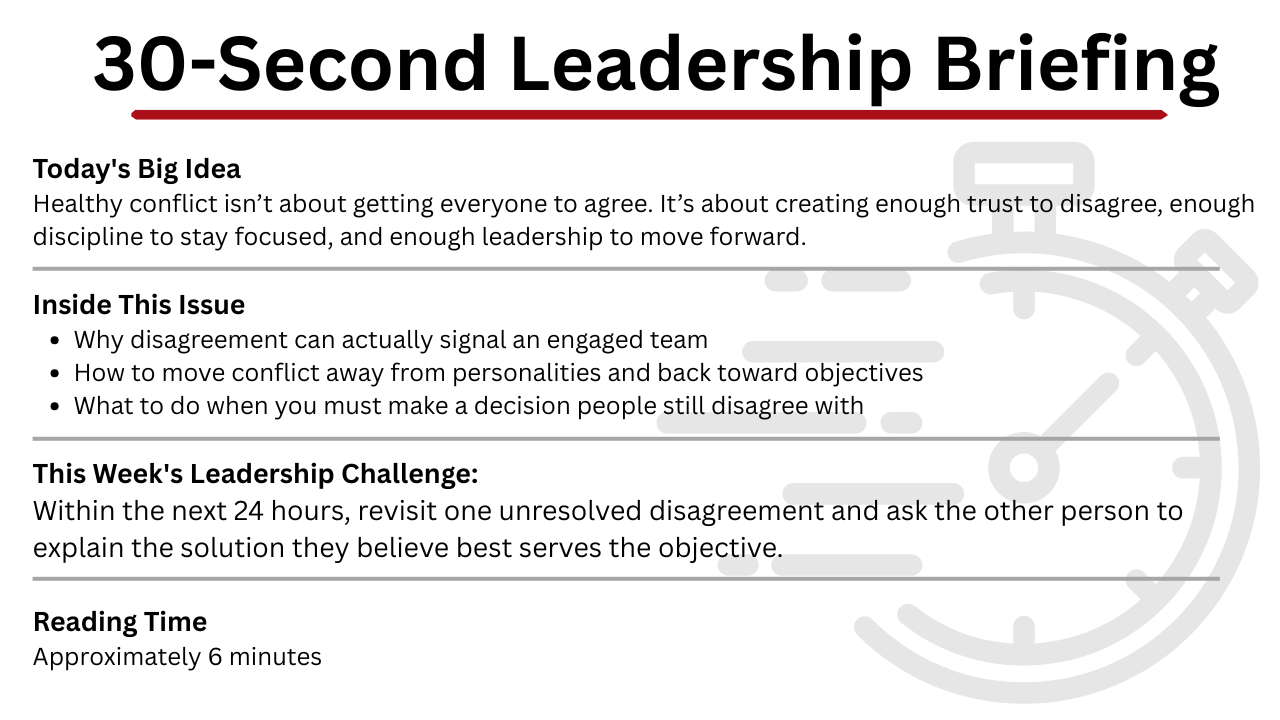
Within the next 24 hours, identify one disagreement, unresolved issue, or competing idea on your team.
Instead of defending your position, ask:
“Walk me through the solution you believe best serves our objective.”
Listen. Ask questions. Then make the best decision you can.
You don’t need everyone to agree with you.
But if you want people to keep giving you their best thinking, they need to know disagreement is welcome, their perspective matters, and your door remains open.
Because how you handle disagreement today determines whether people will tell you the truth tomorrow.
Next Week: Psychological Safety and High Performance: Creating a Team Where People Aren’t Afraid to Speak Up
Leadership Resource of the Week: Download the EXCEL2WIN Leadership Trust Framework and use the Daily Leadership Check-In and Weekly Leadership Scorecard to evaluate how your everyday behaviors are shaping your team. Free download.
Join the Conversation: What does a leader do that makes it easier for you to disagree with them?

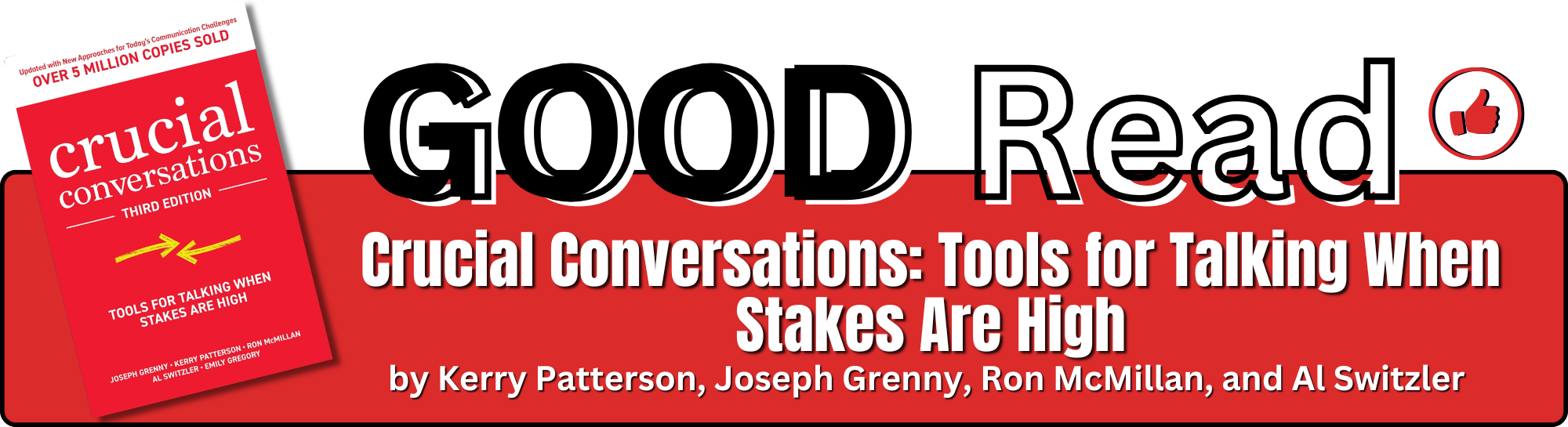
Crucial Conversations
What happens when the stakes are high, opinions differ, and emotions begin taking over?
That is the territory explored in Crucial Conversations by Kerry Patterson, Joseph Grenny, Ron McMillan, and Al Switzler. The book provides practical guidance for navigating the conversations we often find most difficult, especially when disagreement threatens communication, trust, or relationships.
One of its greatest strengths is its focus on creating conditions where people can speak candidly without turning disagreement into personal combat. Rather than avoiding tension or trying to “win,” effective communicators learn to recognize when emotions are hijacking the discussion, clarify what really matters, listen for meaning behind opposing viewpoints, and move the conversation toward productive action.
That connects directly with this week’s EXCEL2WIN message: you don’t need everyone to agree. Healthy teams can challenge ideas, question direction, and offer alternatives while remaining committed to a shared objective.
For leaders, that skill is invaluable. Your authority may end an argument, but it cannot manufacture commitment. Learning to handle crucial conversations well helps preserve trust even when your final answer is still “no.”
If you want to become more confident when conversations get uncomfortable, add Crucial Conversations to your leadership library.
Purchase your copy today, and subscribe to The EXCEL2WIN Leadership Newsletter for practical leadership insights designed to help you grow, lead, and EXCEL2WIN